Photo by Jordan Coll | SOC Images.
The phrase data center tends to evoke an eerie snapshot of Skynet—the artificial superintelligence from classic film “Terminator”—before it evokes progress, and in Hudson County, advocates are decrying those efforts and are not waiting for a sequel.
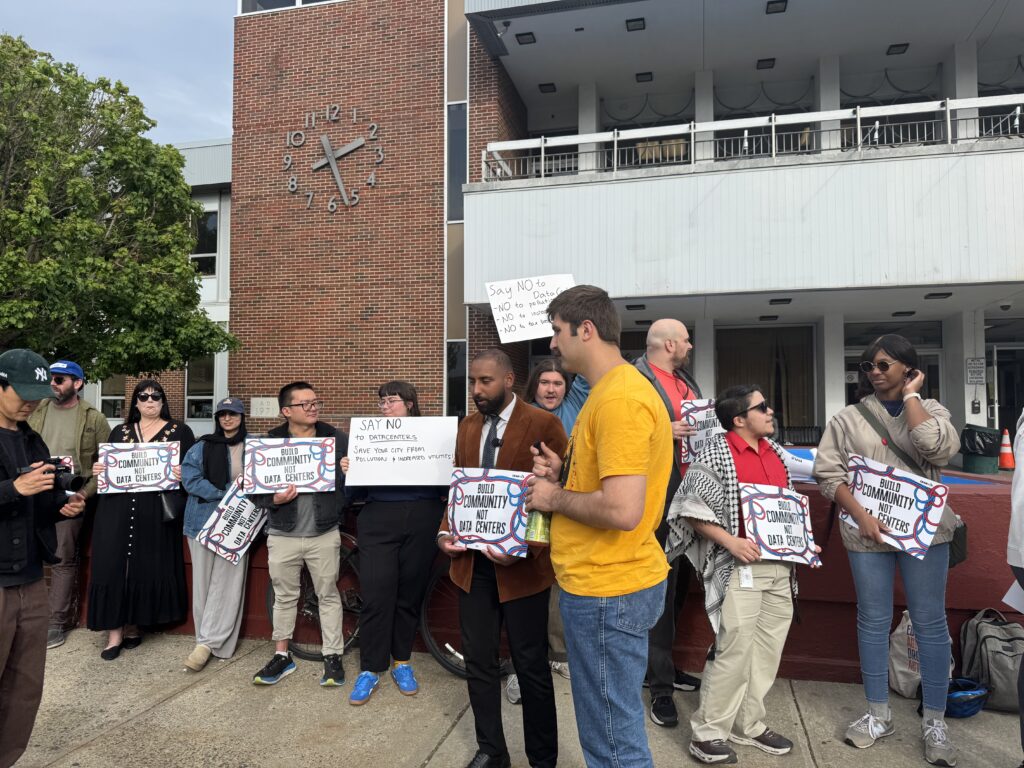
Scores of protesters packed a recent Bayonne City Council meeting to push against the facilities, setting a clear message that a majority are not in favor of New Jersey serving as ground zero for the age of artificial intelligence.
Who Do Data Centers Best Serve And What Is The Reality Building One?
“Tonight we learned that there are three potential datacenters for Bayonne,” said Patricia Hilliard, a lifelong resident of Bayonne and the chairperson of Hudson County Group of New Jersey Sierra Chapter of the Sierra Club during the public comment portion.
In an already charged room opposing the data center, throngs of members dissented on the center’s inception.
“What we would like to see is transparency, where people are allowed to know what is going on and community involvement in decision making, so this is really disappointing,” said Hilliard.
In the meeting, two resolutions were presented by the city council, with the second resolution authorizing a study examining whether the council has the authority to rescind data centers as a previously approved permitted use zone, and seeks to convert it into a binding ordinance.
The first resolution addresses the council as “not allow a data center in the entirety of Bayonne.”
Both measures came after a surge in residents spoke against a proposed data center at the Delta Self-Storage Facility at 71 New Hook Road. Data centers were permitted at that site last December, after the planning board and council voted separately to amend a related redevelopment plan to include the facilities as permitted land use.

Slice of Culture attended the council meeting and spoke to residents who rejected the reality of a data center in the City of Bayonne.
How Data Centers Affects Locals
Chief among the issues brought on by residents is the high demand for water consumption, particularly when it comes to data centers expanding drought prone regions.
“It is detrimental to almost every aspect of the quality of life,” said Jill Pastrino, a longtime Bayonne resident who spoke during public comment, citing the city’s master plan, which she added to the AI centers “would be disastrous.”
A recent report from the New Jersey Policy Perspective (NJPP) think tank found that AI data centers were responsible for 70% of new power demand behind a 20% spike in electric bills in June 2025, and projects they could consume nearly 10% of New Jersey’s total electricity by 2030, according to data by NJPP.
The U.S. Department of Energy (DOE) published that data centers consumed about 4.4% of total U.S. electricity in 2023 and are expected to consume approximately 6.7% to 12% by 2028, driven by AI expansion, manufacturing growth and broader electrification.
On the state front, the New Jersey Senate Legislative Oversight Committee took testimony in March 2025 amid concerns from residents living near data centers about the impact on their energy bills. PSE&G’s Ed Gray reported a steep increase in interconnection requests—from 400 megawatts to 4,700 megawatts in a single year, as reported by NJ Spotlight News.
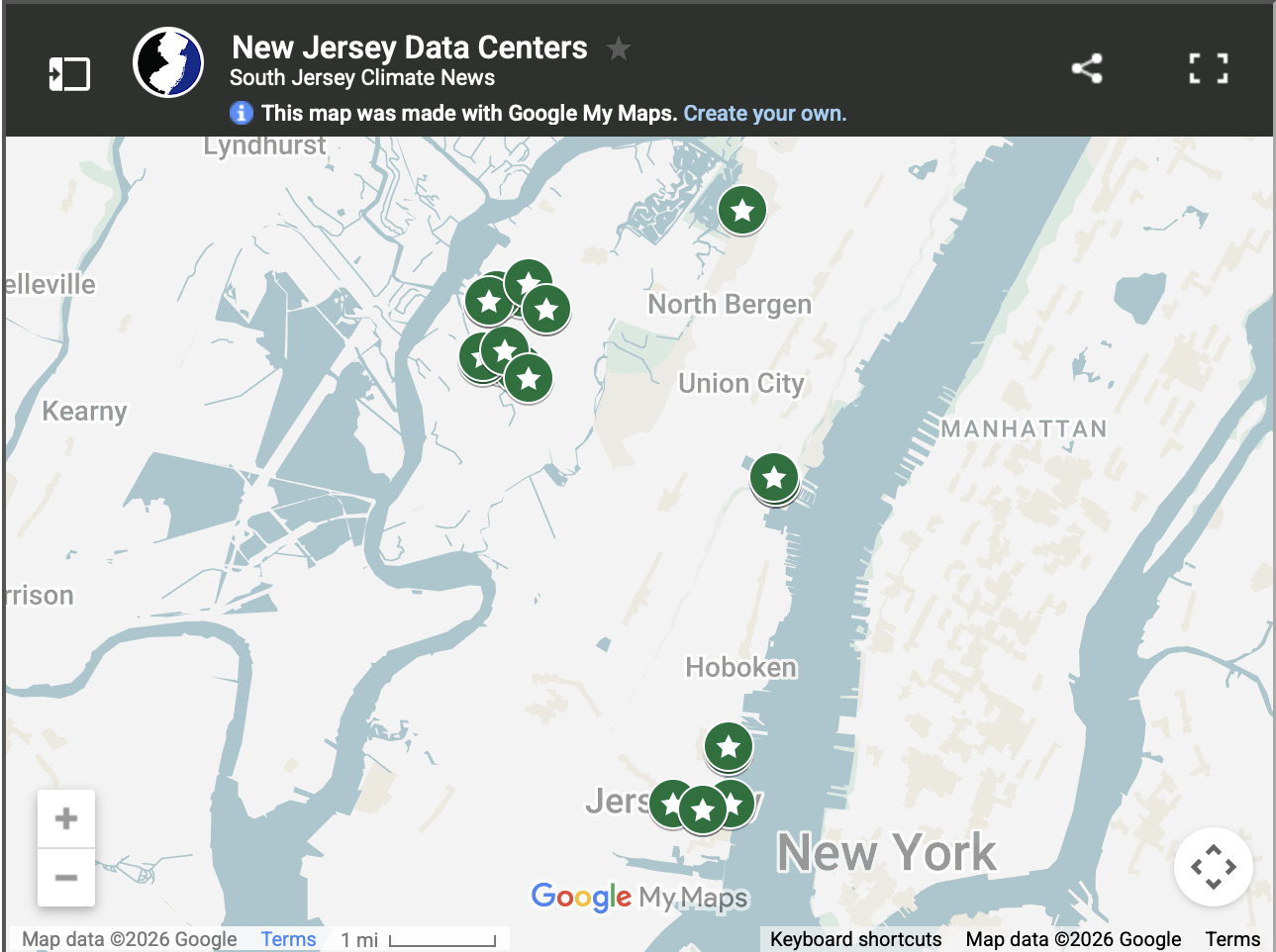
New Jersey currently hosts more than 80 data center facilities, and about 20 are located in Hudson County towns like Secaucus, Jersey City and Weehawken.
As the community fights back against proposed data centers in their backyards, New Jersey lawmakers have passed a round of legislation moving the needle away from the creation of data centers.
The bill A796 AcaAca (2R) would require public electric utilities to protect households and small businesses from soaring costs caused by the scale out of data centers which passed New Jersey’s General Assembly.
“You and I should not be subsidizing data centers. Our electricity bills are skyrocketing and these centers have sweetheart deals. This bill ends that,” said Assemblywoman Katie Brennan to Slice of Culture.
At face value, the bill would require public electric utilities to design special rate structures for data centers using at least 100 megawatts of electricity, which would power tens of thousands of homes.
Under the proposed legislation, it would “impose certain requirements on electric public utilities in order to protect ratepayers,” with 85% of their requested service for a minimum of 10 years, as cited by the bill.
On the state front, Gov. Mikie Sherrill is leveling the playing field when it comes to disclosing the energy and water consumption of data centers every six months. She recently laid out a four part plan that would set guardrails to the facilities setting up shop here in the state in which she took to X, formerly known as Twitter.
The Governor’s Four-Part Plan:
- Require data centers to bring their own clean energy
- Require data centers to report on their energy and water use to the public
- Develop statewide standards for Community Benefit Agreements
- Deliver paying jobs through union contract labor agreements
One big operating entity, which includes the states of Pennsylvania, New Jersey and Maryland or PJM, taking on over 67 million customers, published data indicating that 70 percent of the projected growth is in the demand for electricity.
But supply has not kept pace, forcing utilities to pay more for future capacity—costs that ultimately fall on customers.
Ben Dziobek, the executive director for Climate Revolution, a grassroots advocacy coalition of Gen Zer’s, sounded the alarm on the rapid proliferation of data centers across New Jersey, calling on local communities to take on urgent state-level intervention.
“We need to shine the light right, we cannot regulate what we do not see,” said Dziobek in a phone interview with Slice of Culture, adding that over 2,000 renewable energy projects in New Jersey have been built but ultimately have not been plugged into the energy grid. “They [Silicon Valley and Big Tech interests] are just raking in more profit without actually supporting the system that we all need,” he added.
A key factor Dziobek noted “creates a shortfall” in PJM’s own backlog in connecting new energy projects. In practice, the queue has become a major bottleneck slowing the addition of new supply, as described to Slice of Culture.
He also proposed adding a 5% tax on data centers, with the idea of serving as a revenue stream allocated towards workforce training and legal resources for affected residents.
When it comes to rising energy costs, the surge of data centers brings on a domino effect on energy supply.
“This is all basically leading to this symptom…that is a combination of scarcity on the supply side and due to connection processes that are not designed for the system we have right now,” said Robert Mieth, an assistant professor at Rutgers University Department of Industrial and Systems Engineering spoke to Slice of Culture in an interview.
He noted that data centers which are “significant electric loads,” often make what he described as multiple connection requests often leading to “shadow requests” or built in power plants circumventing already strained energy grids.
“The problem with electricity is that any change in the network affects the entire network in some way,” said Mieth.
The state has created roughly $250 million in subsidies and incentives supporting data center development and the boom has not gone uncontested.
The story of Hudson County’s data centers is increasingly becoming an inseparable phenomena, with residents taking on a financially costly reality. Large data centers can consume up to 5 million gallons of water per day, with approximately impacting the water table use of a town with a population of 10,000 to 50,000 people, according to figures cited by the Environmental and Energy Study Institute (EESI).
The annual figure of water consumption from a bigger data center is 5 million gallons per day or roughly 1.8 billion.
“When data centers are built, they raise utility rates for nearby communities. That’s us,” said lifelong resident Crystal Aponte at the May 13 council meeting.
“As demand surges, utility companies pass the cost of infrastructure upgrades and increased energy procurement onto residents and small businesses through higher rates. Bayonne residents have already seen an immense increase in their electricity bills, and this would only make it higher.”
Back in Bayonne and throughout Hudson County, residents worry that the need to suffice the energy demands of A.I. data centers will be costly to both the environment and their wallets.
“I mean it’s a serious thing we are going through,” said Darlene Danega, who has lived in Bayonne her entire life and spoke to Slice of Culture outside the council meeting. “I think they were bought off by [Bayonne City Council]…I think they were given a promise of a lot of money and the people came out.”
The Bayonne City Council in a 5-0 vote approved both resolutions at the April 15 meeting. If you want to stay informed on the latest developments when it comes to data centers in New Jersey you can visit the following sites for more info:
Your local catch-up! Sign up for our biweekly newsletter for local events, more community stories, exclusive wallpapers and more!