

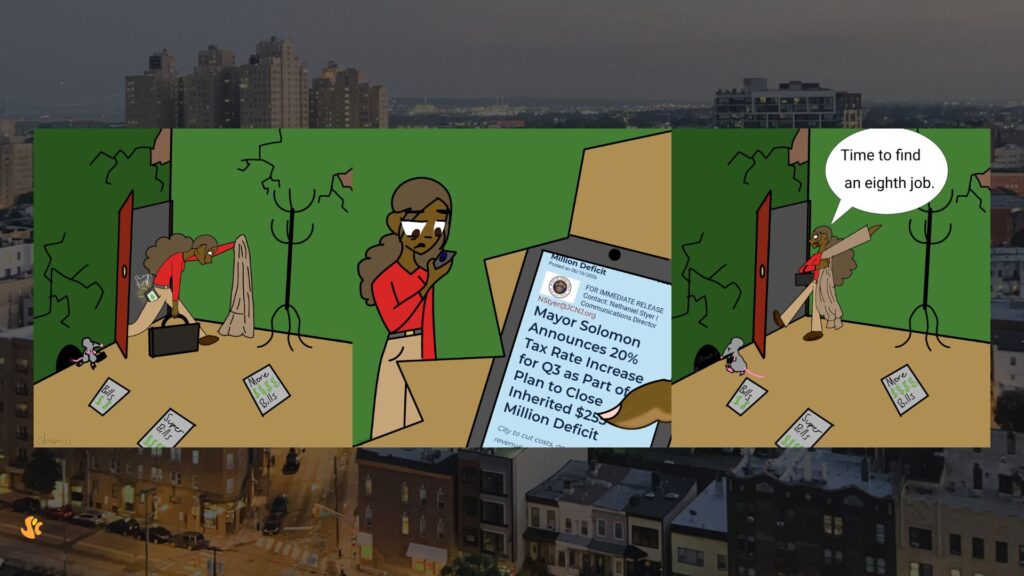
Illustration by Elizabeth Romage / SOC Images.
Editor’s Note: This article was updated to include that July 15’s council meeting will be voting on the introduction of a 15.5% increase, according to a city official who reached out to Slice of Culture.
John Q., who’s better known by his nickname “Quick,” has been in Jersey City his whole life and said that nothing surprises him—not even the proposed 20% property tax increase by Mayor James Solomon.
Walking around Martin Luther King Drive in the Greenville area of Jersey City, Quick was one of the residents who openly spoke to Slice of Culture about the proposed property tax increase, which has been swaying at either 15% or 20%. The Jersey City native emphasized how residents have been struggling with the increased costs of living and how “we ain’t got nothing as is.”
“We lose either way you put it, we lose,” Quick, who’s a Jersey City city employee, told Slice of Culture. “I lose no matter how you put it. I don’t care how you draw it out. Lay us off or go up on taxes. I still feel it.”
That somber feeling was felt among the residents that Slice of Culture spoke with. And still, for them, they knew one thing for sure: they’ll be at Jersey City City Hall public meeting on Wednesday, July 15 at 6 p.m. ready to speak up.
At this meeting, the city council will reportedly be voting on the introduction of a 15.5% property tax increase, according to a city official who reached out to Slice of Culture following publication of this article.

Ever since Solomon announced his proposal of a property tax hike on June 24, in efforts to solve their major municipal budget deficit, residents have been buzzing with how the city’s financial fiscal books seem to be up in the air. Now the question remains on how a 20% municipal tax hike could trigger a monetary armageddon to the everyday resident, while also uprooting entire communities who have spent their lives in a city they are still looking to call home.
How we got here remains spotty, but Slice of Culture has worked to stitch together the context of the city’s financial woes and what an increase would actually materialize in the wallets of the average Jersey Citian.
What The Solomon Administration Claims Is The Reason
On face value, the Solomon administration has claimed that the practice of under budgeting city line items and then declaring an emergency at the end of the year, had become a tactic of the previous Steve Fulop administration—who was mayor of Jersey City for 13 years— in addition to deferring retirement payments.
“That process needs to stop,” said the city’s Director of Finance Bill Viqueria in an internal meeting, which Slice of Culture was in the room at the time of the press briefing.
The director also made known that once he began reviewing the city’s 2026 budget, “what was being budgeted was already far less than what the city had incurred.” In other words, the revenues were not keeping up with the accrued expenses.
City layoffs took a trim off the deficit, with 36 city provisional employees laid off last Friday, according to an email sent to Slice of Culture by the city.
“Our original proposal of 20% city tax rate increase was intentionally designed to protect jobs,” said Nathaniel Styer, the city’s communications director to Slice of Culture.
But after the public protest of the 20% number, the administration had to regroup.
For example, if the city agrees to a 3.5% annual raise, it does not just apply going forward; the city owes that raise retroactively for every year the contract is unsettled. That adds up to roughly $12 million that should have been budgeted for this obligation but wasn’t, as stated by city officials to Slice of Culture.
More Than The Money: The Crushing Impact On Jersey City Residents
According to the Solomon administration, Jersey City homeowners could see their tax bills jump over $1,600 next year.
The typical home in the city—assessed at about $480,000 in 2025—owed an estimated $11,203 in property taxes, according to the city’s online tax calculator, a figure state data suggests is roughly average. Under one of the proposal’s, if city property taxes increase to 15% and both county and school taxes 14%, that homeowner’s bill would climb to $12,825.
An average increase per month on homeowners—with a proposed 20% increase—breaks down to costs of Jersey City ($51), Board of Education ($63) and Hudson County ($25), according to data obtained by Slice of Culture from the city.
But throughout Jersey City, the ripple effects that residents are feeling are translated to real, tough everyday decisions; decisions like choosing between paying your rent on time or getting groceries for your next meal.
In Ward F, specifically in the Martin Luther King Drive neighborhood, people like Quick, John Mines and Derek all told Slice of Culture that everyone’s going to be affected and more needs to be done to save them.
“Taxes going up affects everybody here in the city of Jersey City. So we have to be really, really careful about what we voting on and how we gonna move this legislation [be]cause it affects everybody, especially in this county,” said Mines, who stopped at a red light at the corner of MLK Drive and Oak Street.
A few minutes later, Derek—who’s been living in the city for 60 years—strolled down the same block. He said though he’s retired, taxes shouldn’t be this way.
“The tax [is] supposed to go down, man. I don’t know why the tax[es] are like that… The tax[es are] killing the people… people losing the house and everything. [It’s] messing up everybody,” he said.
“[To Solomon,] do better. You gotta bring the tax down… control the rent. The rent is too much. The tax[es] and food [prices] is going up. Everything [is] going up. And the poor people can’t make it. They’re sleeping in the street and all over. It’s not easy.”
Tina Nalls, a community advocate, owner of nonprofit Community Treasures and aide under Councilman Frank Gilmore, also added that the increased cost of everything isn’t allowing people to “enjoy” their lives.
“Because a lot of people in our community work at Burger King, McDonald’s. Even me, when I was working at Abbott, the program at the Board of Education, I still had to go and get another job to work at Target to make ends meet just to pay rent… That’s why a lot of people hurt because we only working, we not really enjoying each other.
– Tina Nalls
We just working and stuff just to maintain and make sure our family good. So to see that happen, we’ll never be able to grow because it’s not about us working so much. It’s about us building and coming together and being able to share more memories together.”
What’s Been Happening At CIty Hall
On the other side of town, at a July 1 special City Council meeting, the council was at an impasse on approving an agreement with the state on a 20% tax increase.
“I thought for the first time, maybe Jersey City isn’t my home anymore,” said Charlene Burke, who has lived in McGinley Square for over 20 years, during public comment at the City Council special session meeting held on July 1.
The special session on July 1 discussed the budget’s financial undertones, and an agreement made with the state of New Jersey, with an already expired deadline of June 30.
The council unanimously (9-0) rejected a resolution that would have triggered a 15% tax increase on this year’s Q3 tax bills, a move many members of the public leaned on, and the council also beckoned the outrage.
“Without seeing a budget and looking at every single dollar being spent, I cannot responsibly look you in the eye and raise your taxes,” said Ward C Councilman Tom Zuppa, adding that a city-wide tax levy increase was inevitable.
He also emphasized a resolution co-sponsored by his office and Councilman at-Large Rolando Lavarro, calling for an investigative audit into the affairs of the Fulop administration between 2020 and 2025. Slice of Culture sent an OPRA request on the audit report, but none have been provided at the time of this reporting.
Others signaled that the city’s proposed budget had not been disclosed to the public which makes up 36% of what you are taxed under municipal law, 43% is to the Board of Education and 17% is towards the county.
“I want to know where you’re spending my money… why can’t we see a line item budget?… I’m very very upset for my neighbors, my friends and myself,” said Rosanna Vargas, a member of the public who spoke at the special session meeting.
“Is there a document that can show us that this is the case?” asked Esther Wintner, a civic advocate and former city At-Large council candidate, who inquired on the scenario in which the state can potentially place penalties if the terms of the MOU are not met.
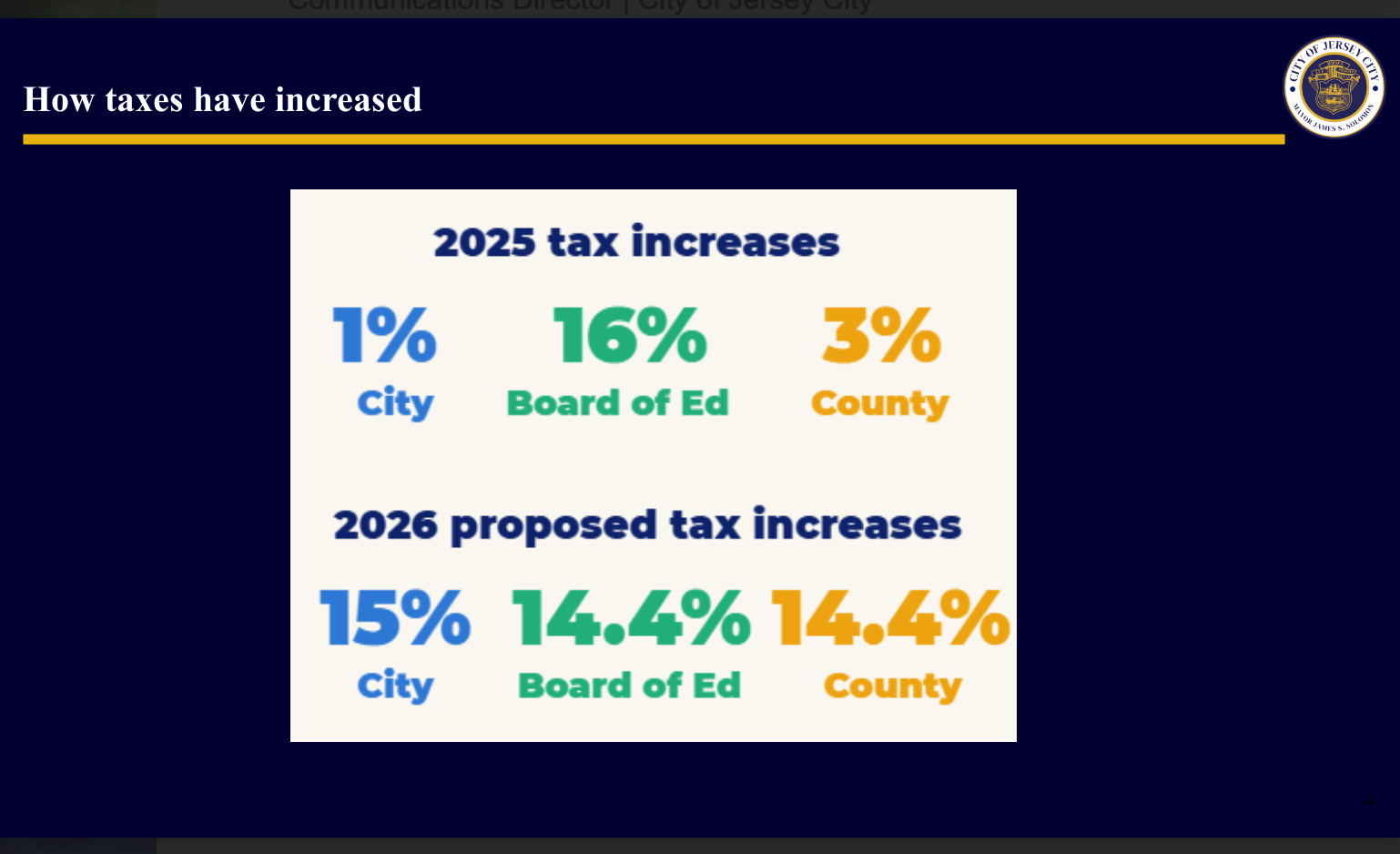
In the span of five years, Jersey City has seen a 2% total difference from 2020 through 2025 while the BOE had a 157% spike of a total change. The BOE approved their budget of $1,096,541,152 for the 2026-2027 school budget, with approximately 15% of an increase.
Continuing the conversation at the July 13 Caucus meeting, the 12% tax rate for residents to pay was a lingering avenue, which a majority of the council approved in lowering the tax burden from the mayor’s proposed 20% to single digits are not in agreement with the state’s Memorandum of Understanding between Jersey City and the Department of Community Affairs (DCA), as told to Slice of Culture .
Council President Denise Ridley surfaced a few requests she made on her behalf, related to a list of new employees hired from the start of the year, a review of assessed PILOT agreements and a list of the provisional employees laid off.
“We made requests that we have not heard back from yet,” said Ridley, who noted she made these requests on July 1.
The looming budget and realistically what the final percentage would come down to is still a talking point of perplexity among council members.
“I’m coming short of saying the L-word on this,” said Councilman at-Large Rolando Lavarro, who took issue with allegations that the city council’s budget for salaries and wages was increasing by 20%, a point that he debunked. “Look with your lying eyes on this budget and you’ll see,” he said, referring to the proposed budget put out by the Solomon administration on July 10 and circulated to members of the press.
Another idea to cut down on the percentage of tax increase included efforts enforcing traffic fees and grants, in addition to supporting seniors with the senior property tax free, also known as a mortgage freeze.
City officials have added to Slice of Culture that the administration instead bonded for these costs, using five-year deferred charges, meaning the city borrowed the cost rather than paying into the city expenditure expenses directly.
Most of these union and city contracts expired in 2024, though one union’s contract has expired since 2019, translating to seven years without a settled deal, which was confirmed by city officials to Slice of Culture during the July 13 meeting.
Because those contracts weren’t settled, union members didn’t receive raises in 2025, which artificially lowered the city’s 2025 salary costs on paper. But when a contract is finally signed— say in 2026—the union will demand back pay and retroactive pay to make up the difference.
“The root cause of your problem is the accounting element has been torn out of the Finance Department and City operations over the years, mostly due to turnover and shortages of detail-oriented personnel,” wrote Jack Scura, the city’s former Acting Chief Financial Officer, with over 30 years of experience as a certified public accountant (CPA) and advocate, in an email to every councilmember at that time, dating back to July of last year.
“I could tell we were having a hard time paying bills,” said Scura, who told Slice of Culture he sounded the alarm on the city’s budget in 2022, as he pointed out the tax rate of the city was low; that year Jersey City’s tax rate went up 32% from the previous year, according to state records.
“It’s not taxpayer friendly in other words,” he said, “Now the burden of running your government is on the property taxpayer.”
How Did Jersey City Get Here? Looking Back At The Fulop Administration
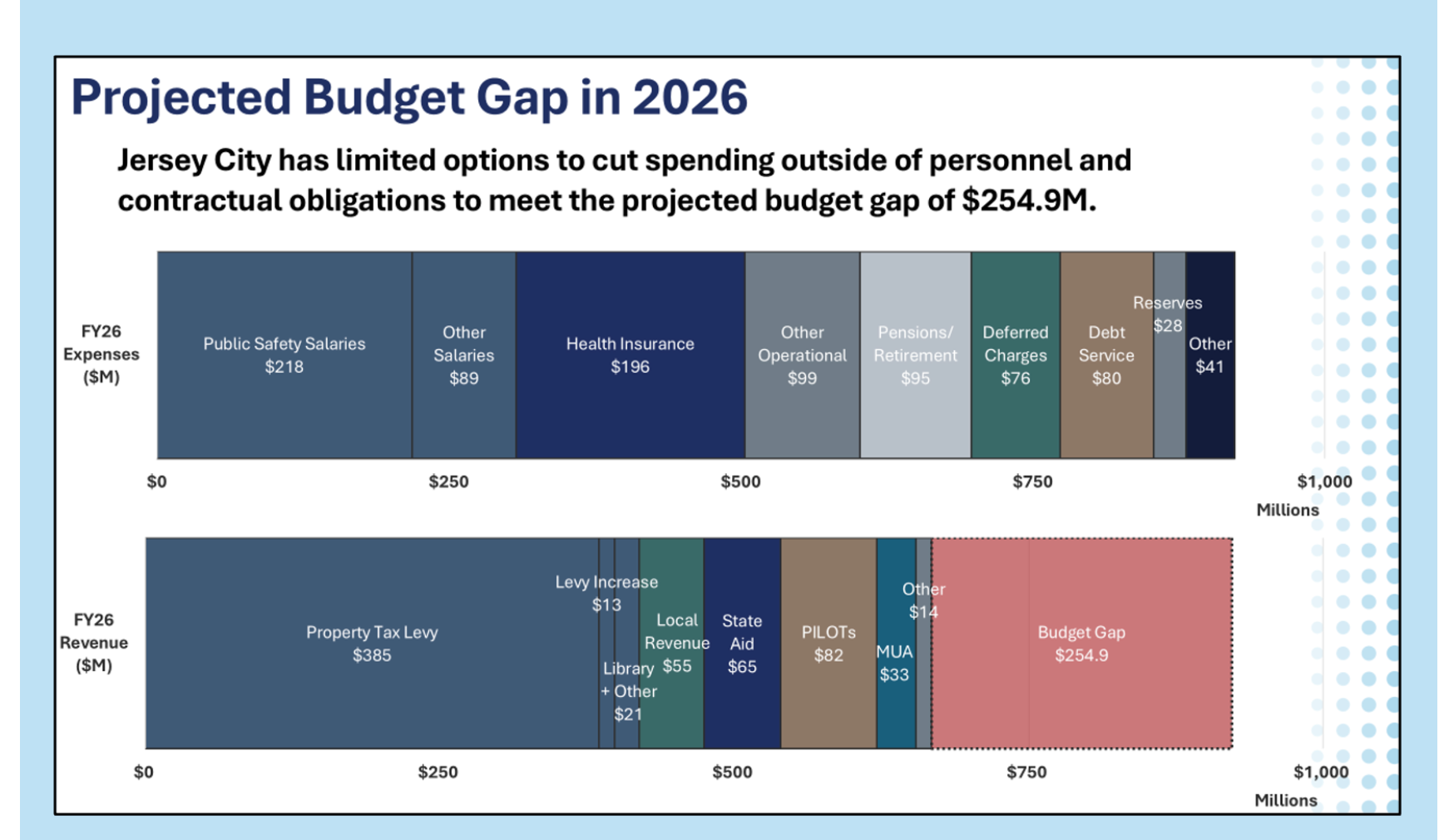
The waning figure of the initial $255 million budget deficit is funneled in a myriad of unpaid city costs, with $90 million being the city’s price tag revealing its structural deficit.
Former Mayor Steve Fulop—who is now the chief executive officer at The Partnership for New York City, a nonprofit organization of over 300 top tier clients such as Google, JPMorgan and Verizon, among other high profile clientele—did not respond a request on the tax hike inquiry from Slice of Culture at the time of this reporting.
An additional caveat to Jersey City’s financial footing is the exemption of $2 billion of property taxes through the city abatements, a municipal or government subsidy on property taxes, which had cost the city to lose approximately $120 million in annual revenue, according to a state comptroller report in 2010.
“This is a structural mismatch between revenues and appropriations,” said Solomon, noting that unpaid healthcare bills from 2024 and 2025 racked up to be $52 million, according to the city’s Financial Emergency Report on the site. In the mix was the city’s deputy mayor Keshav Poddar, Steve Weilcotz and Matthew Weilcotz who are both certified public accountants, at Weilkotz & Company, LLC.
“It was deception, it was gimmicks, it was irresponsible decision making, it was vanity and it was incompetence,” said Solomon, referring to the previous Fulop administration on how it hashed out the city’s monies. When it came to healthcare costs, the 2025 budget set aside an estimated figure of $147 million for employees and retirees, but according to a press release by the mayor’s office $195 million was the actual cost—a price gap of $48 million.
He discussed retirement payouts and terminal leave. When it comes to retirement of city employees he estimated the annual cost to be $11 million, though the exact figure depends on how many employees actually retire. The newly released city budget for 2026 totals up to $866.5 million, compared to last year’s budget of $781 million, or an 11% increase.
At the top tier of the city’s payroll ladder, the department of Public Safety budget for 2026 is $219.5 million compared to last year with a budget sum of $211.7 million.
The Jersey City council also made a deal two years ago with the state to raise taxes 2% annually in the span oof five years.
He added that part of the fiscal deficit price tag of $255 million stems from:
- Late payment to vendors
- Racked up late and penalty fees
- Deferred charges and emergency appropriations
- Issues to tracking on city invoices.
Another independent auditing firm, Donohue, Gironda, Doria and Tomkins LLC, the city’s independent auditor, has been in contract with the city for six consecutive years. Slice of Culture also reported this year’s county tax levy for Jersey City would be going up by 14.92% in which each municipality varies on the tax rate and allocations costs for public services.
Disgruntled residents at the July 1 meeting pushed back on the narrative that 20% was at best all the city could come up with. The outcry of the public became palpable at City Hall as scores of residents broke the silence on a 20% placed under a Memorandum of Understanding (MOU) between Jersey City and the State’s Division of Local Government Services (DLGS), with a $120 million financial rescue package.
For Meng Wu, she’s been living in Jersey City for 15 years. She came from Toronto to be closer to her New York City job and has never wanted to leave the Hudson County town after immersing in its community and culture. But after looking back at everything that’s happened, she feels “betrayed” by Fulop and understands that Solomon inherited bad debt, but is hoping that he will get the city out of it.
“If he doesn’t find a solution, I’m going to be very disappointed because it’s his job to get us out of this trouble.
– Meng Wu
I hope he’ll figure out something… I think people who have a way to get out, they will and that’s really sad because people who can afford to move, they’ll move. And you’re left with the people who are stuck here and cannot move, and they’re the people who are most vulnerable to an increased cost of living. So we shouldn’t do that.”
The mayor held another meeting on June 28 at the Miracle Temple Pentecostal Church, and spoke about the city’s share of the property tax increase being 36%, the Board of Education (BOE) and Hudson County accounting for 43% and 70%, respectively.
Solomon emphasized the need for state aid, securing $120 million and direct fund allocations towards maintaining public safety and essential city services.
And after all the suggestions, back-and-forths, resident worries and more, the verdict hasn’t been set yet.
“I think [Solomon has] done a good job, but please do better, because good is not good enough. It’s people’s lives at stake and we don’t want a city to go bankrupt, so please do better and do your best,” Wu said.
The conversation and decision on how much property taxes will increase will continue Wednesday, July 15 at 6 p.m. at 280 Grove Street. You can sign up to talk at the meeting here.




3 Responses