Photos by Jordan Coll / SOC Images. Graphic by Adrienne J. Romero / SOC Images.
As Jersey City’s Board of Education approaches a turning point, a 14.4% tax increase and a shrinking state aid budget, its left voters asking what the new slate of candidates can realistically deliver for the city’s education agenda.
Residents will be hitting the voting polls once again on Tuesday, Nov. 3, and they need you out there too. On the ballot—along with choices of U.S. Senator, U.S. Representative and County Commissioner—three slates are on the panorama of the Jersey City Board of Education (JCBOE) race, vying to fill in four seats.

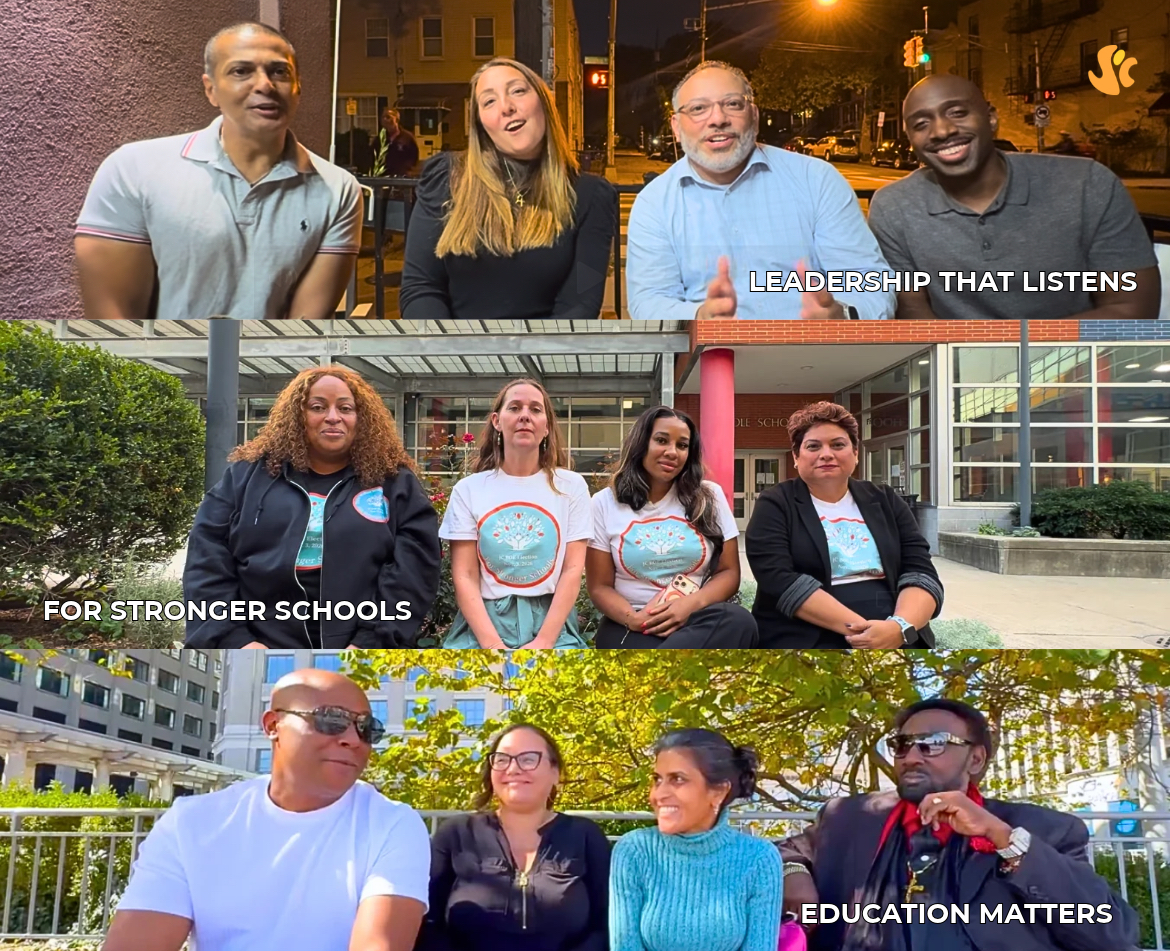
Leadership That Listens, Education Matters and For Stronger Schools are the names of the slates comprising 12 candidates for a body of nine trustee members.
Before meeting the candidates, let’s give you a breakdown of the current JCBOE and their budget.
The JCBOE has been in the news as of late; from the recent visit of FBI agents to the superintendent’s office reported by Jersey City Times, to a tax increase of 14.4% (the largest portion of the resident’s tax bill) and then amending the state education formula—also known as the Abbott formula—which has not been changed since 2018, that would allocate monies to the school district varying by municipalities.
Slate members who spoke to Slice of Culture offered a glimpse on how their platform sees things for the trajectory on education headed into this year’s Board of Education.
The JCBOE approved a budget of $1,096,541,152, for the 2026-2027 academic school year. Trustees Dr. George Blount, Dr. Matthiew Schneider and Lorenzo Richardson were the dissenting votes.
The larger task, noted slate members to Slice of Culture, goes to focusing on a clear public accounting of the district’s finances and financial transparency, deliverance in state aid to be funneled back in the classrooms and a 10-year facilities plan built on enrollment projections and housing growth.
The board has only recently regained full control of the district, which currently serves 26,393 students, according to the budget overview for the 2026-2027 BOE, reviewed by Slice of Culture. In the 2024-2025 school year, the enrollment was a total of 29,037 students.
In September 2022, the state determined that the district had implemented its transition plan, and the State Board of Education approved returning it to full local control. That return came after decades of state oversight, and the board has since had to manage a budget that keeps tightening, as expressed by candidates running for the BOE to Slice of Culture.
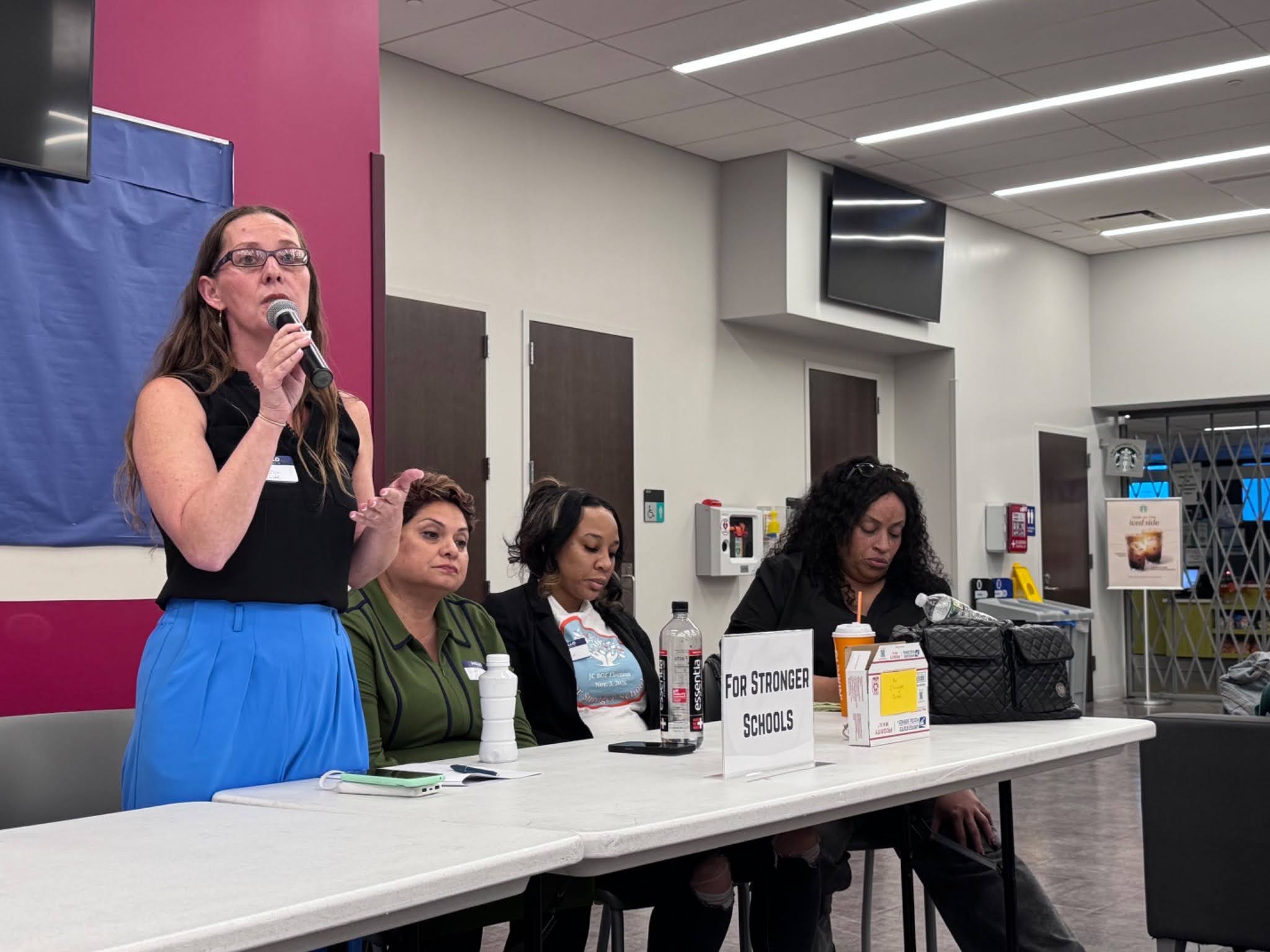
Candidates spoke to Slice of Culture on what they have planned for the BOE.
So Who Are They?
Leadership That Listens is running Julietta Vogt (7G), Videsh Bahadur (8G), Fernando Garcia (9G) and Zebedayo Mosongo (12G). The slate is endorsed by the Jersey City Education Association, public school alumni and two parents with children enrolled in Jersey City Public Schools (JCPS). They have been endorsed by the Jersey City Education Association (JCEA), a local teachers union. For Leadership That Listens’ full interview, watch it here.
Education Matters, made up of incumbent members, is running Dejon Morris (5G), Dr. George Blount (4G), Alpa Patel (6G) and Vanessa Rodriguez (11G), which has received a separate endorsement from Ward F City Councilman Frank Educational Gilmore, but did not endorse the rest of the slate members, according to reporting by Gothamist. For Education Matters’ full interview, watch it here.
For Stronger Schools is running Jessica Taube (1G), Danielle Walker (2G), Chloe Williams (3G) and former board trustee Gina Verdibello (10G). The slate has received endorsements from several local and state officials, State Assemblywoman Katie Brennan (D-32) , County Commissioner Bill O’Dea (D-2) and Yraida Aponte-Lipski (D-4). For For Stronger Schools’ full interview, watch it here.
Slice of Culture reached out several times to Jersey City Public Schools Superintendent Norma Fernandez on what the transition of voting in new slate members would mean in terms of education policy for the JCPS, but no response has been provided since the time of this reporting.
School Funding And Facilities
Money was the first issue to surface and how to funnel those funds into the classroom when it comes to the BOE education formula (S-2 bill), funded under the School Funding Reform Act of 2008 (SFRA), which allocates state aid based on student needs and a district’s property wealth.
The bill was fleshed out in 2008, after the onset of years of legal hurdles stemming from underfunded school districts as cited in an education report by the New Jersey Policy Perspective.
The board recently unanimously approved a resolution, asking the state to review its school funding formula “on high-need school districts located within rapid development municipalities.”
Most state funding formulas are tied with a district’s student needs, such as the number of low-income students, English learners and students with disabilities, which factors in the cost funded by local property taxes.
In the case of Jersey City, new housing and commercial development can raise the town’s taxable property values on paper, which may reduce the state aid of what the district needs, as previously reported by Slice of Culture on the city’s breakdown with a recently approved 15.15% tax hike.
Morris, the board’s vice president running in the slate Education Matters and who took office in 2024, said the formula has not kept pace with the city’s growth.
“As is today with Jersey City with all the new developments that are going up, the formula is stuck, it needs to be revised,” he told Slice of Culture.
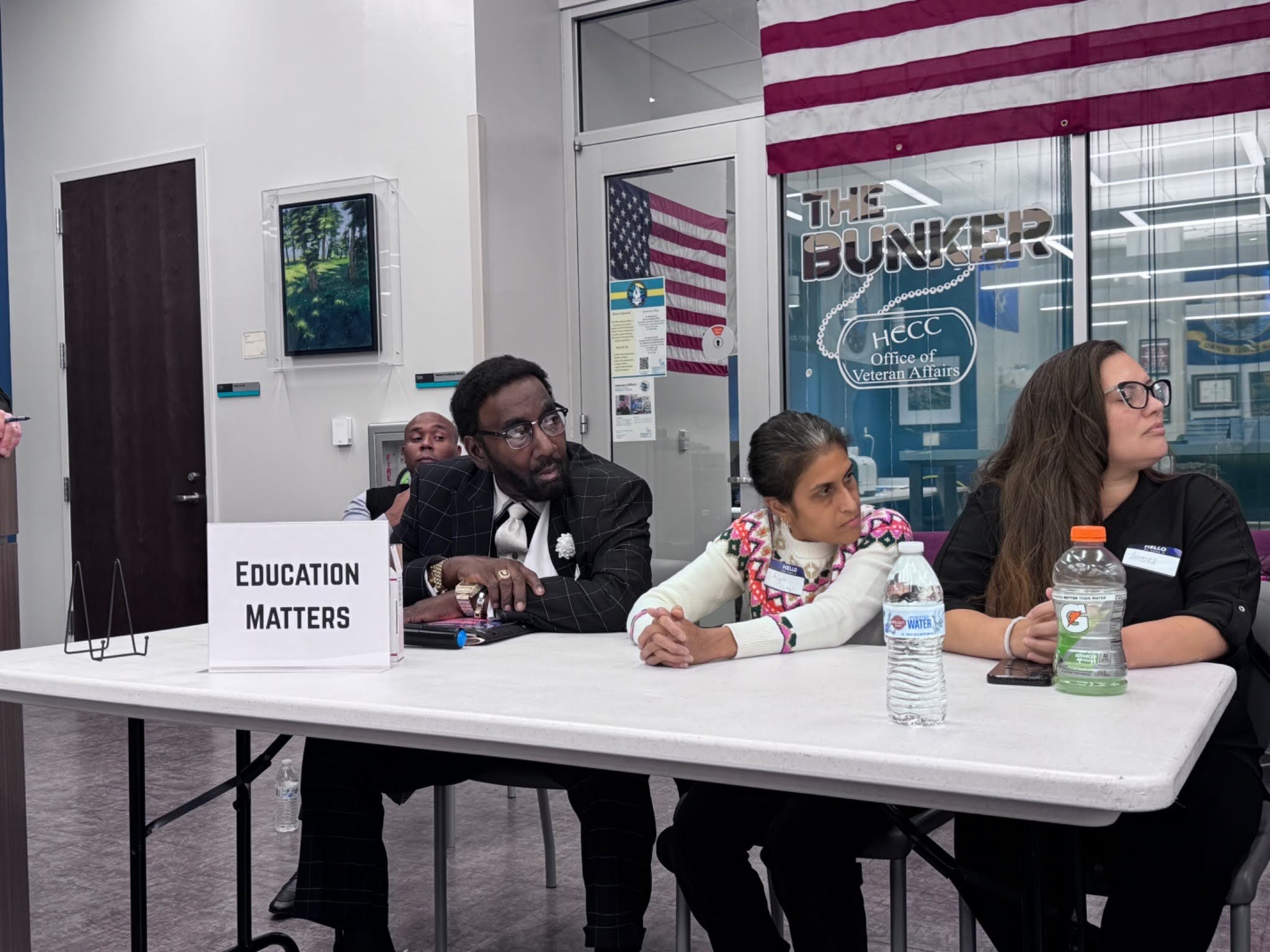
He argued that the formula does not account for new residents arriving with those developments and said that from the state level Jersey City’s BOE is perceived to be “a rich city with a poor Board of Education.”
“We have not made provisions within that formula to make sure that we have more schools that are built along with development,” Morris added.
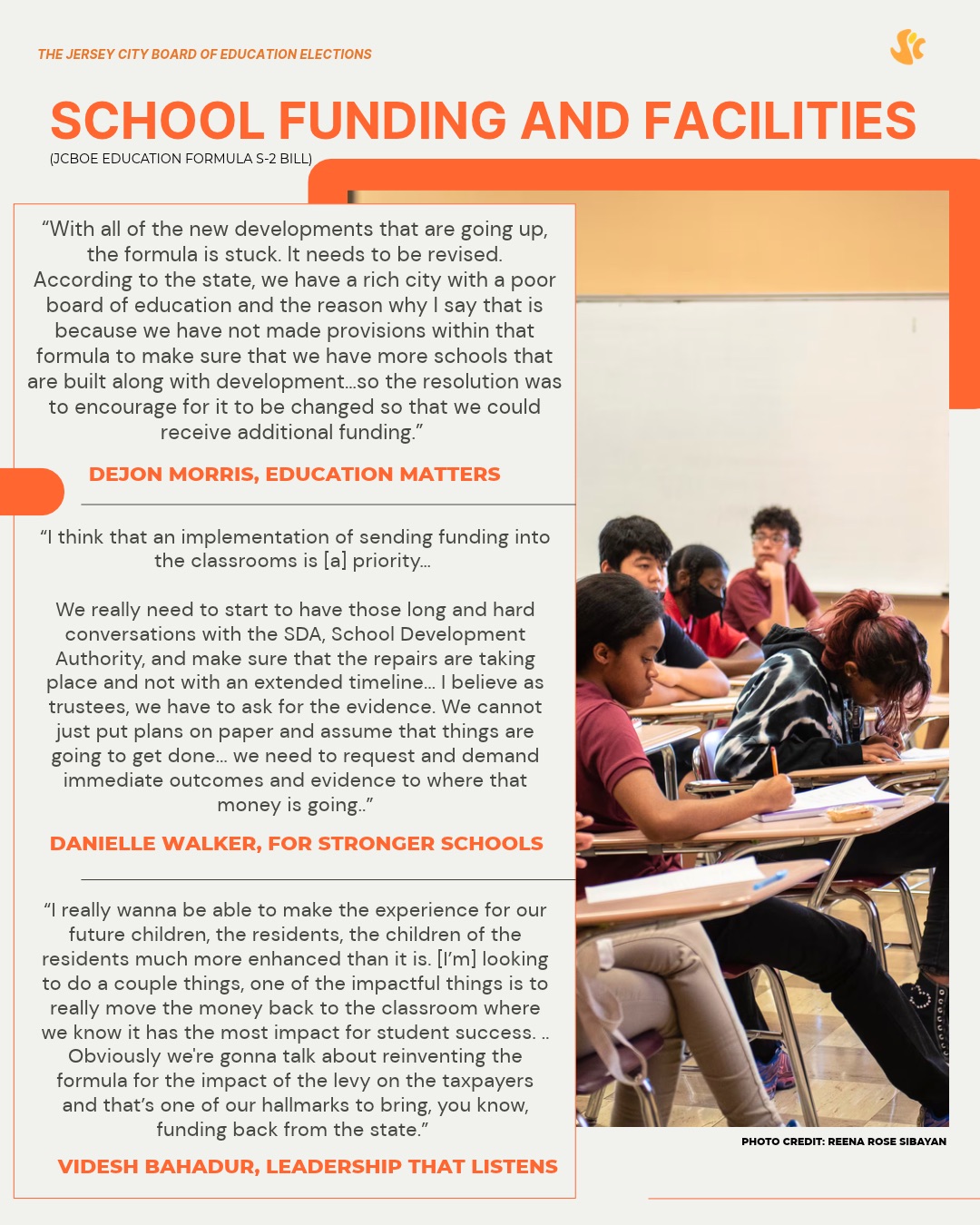
Bahadur, a parent of a 12th grader running in the slate of Leadership That Listens and a product of Jersey City’s K-12 public schools, framed the issue around the district’s tax burden.
“We want to move the money back into the classrooms,” he added.
He called for restoring state funding levels so that the 14.4% board of education tax levy as reported by Hudson County View, “does not disproportionately affect people in different communities.”
Walker, a candidate for the slate For Stronger Schools and mother of three JCPS graduates, focused on enrollment, staffing and the condition of the school’s building infrastructure.
“I feel the immediate steps would be to look into the numbers of our enrollment, the predictable numbers based on every school and what enrollment numbers look like,” she said.
Additionally, she would push to make sure classes are fully staffed and services are accessible to every group in the district.
“We look at all of those cohorts that exist within the district and make sure that we are providing services that are easily accessible for those groups to thrive.”
She also emphasized repairs to school infrastructure are essential to learning, and she called for harder conversations with the state’s Schools Development Authority (SDA) about fully funding 31 school facility projects in “SDA Districts.”
“What we are seeing is that repairs that are not being prioritized, buildings are getting worse, so we want to cut that off.”
*Slice of Culture teamed up with Branch Four Data Lab, a nonprofit organization, to create a “Campaign Finance Tracker” and look into ELEC contributions of Hudson County candidates and elected officials.
The ‘Bell-to-Bell’ Phone Ban
The candidates were also asked about the state’s “bell-to-bell” K-12 cell phone ban, what’s the ultimate goal and how they would implement policies supporting it.
Garcia, who is running under the slate Leadership that Listens, holds an at-large seat and teaches at Ocean County College as a lecturer, said he sees the issue two-fold, as both a parent and an educator.
“As a parent it is a tough issue, I always want to have insurability that I have access to my kids and they have access to me,” he said.
As an educator, he added, classrooms have lost ground to social media.
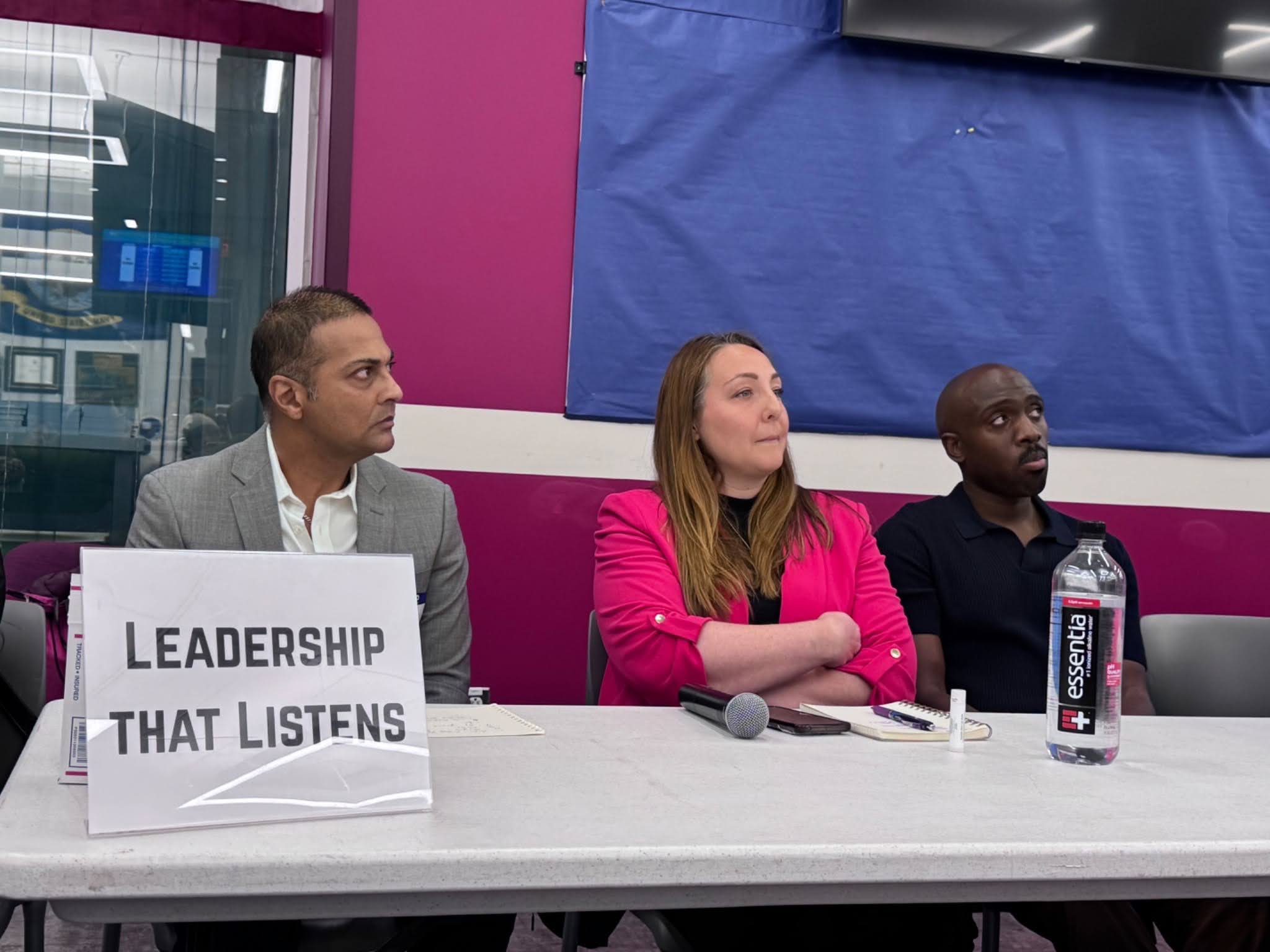
“We do less engaging conversations in our classrooms with our students and those conversations are happening on social media, and I think that is where students are having the biggest gap,” he said.
He alluded to Australia’s nationwide restrictions on a cell phone ban for children 16 and under as a similar attempt.
Patel, a current trustee and running for Education that Matters, said she surveyed students at two schools and the response was favorable. She noted that enforcement has tightened: phones were allowed last year, but are banned this year.
“I believe there is more work to be done,” adding that phones affect students’ academic performance in the classroom.
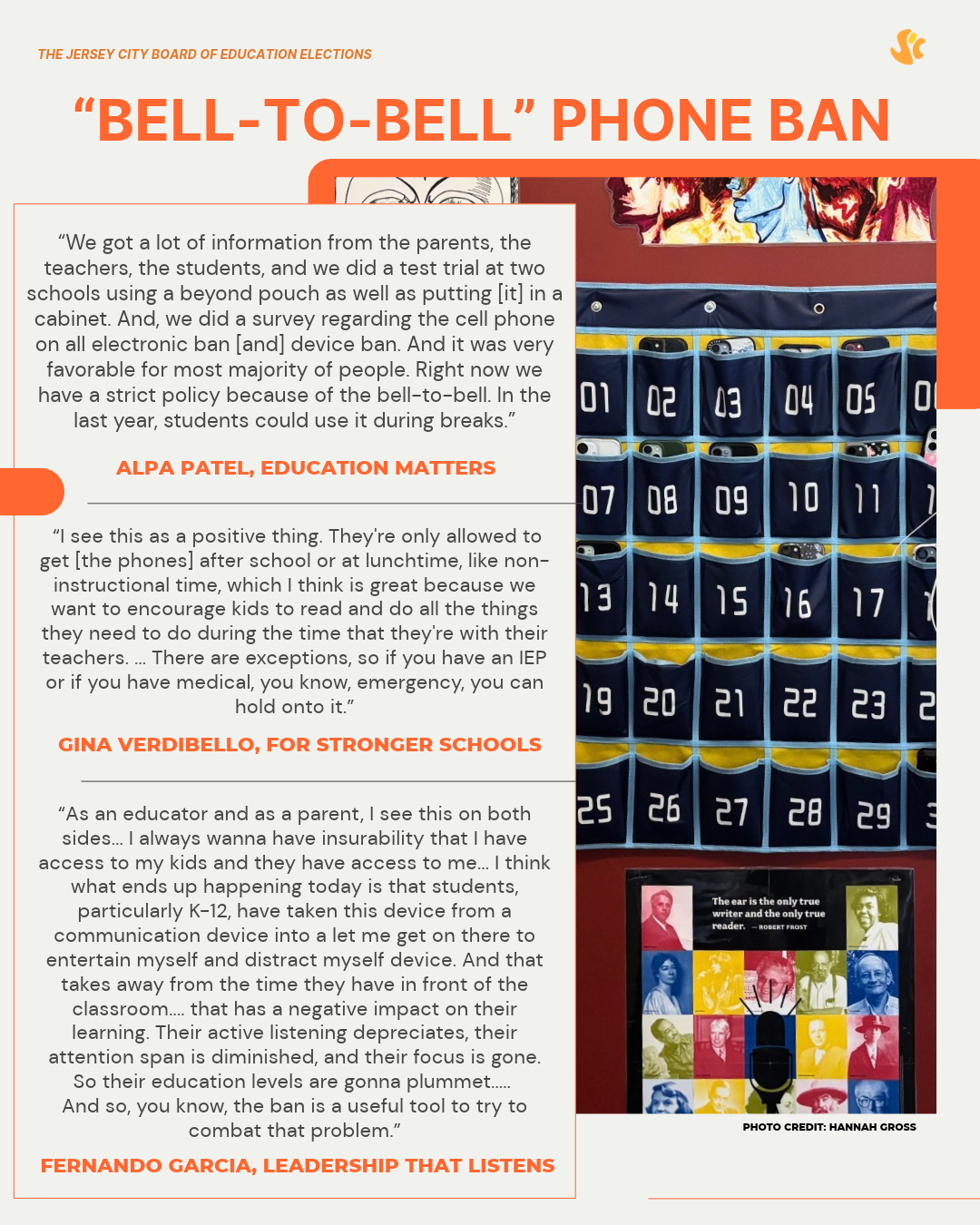
Verdibello, who served on the board in 2019 and is running as part of For Stronger Schools, said the district was early to act.
“I see this as a positive thing… it is a good thing that the Jersey City school district was ahead of the game.”
She cited a Rutgers University Eagleton Institute of Politics survey, previously reported by Slice of Culture, finding that more than eight in 10 New Jerseyans support the statewide ban.
A.I. In The Classroom
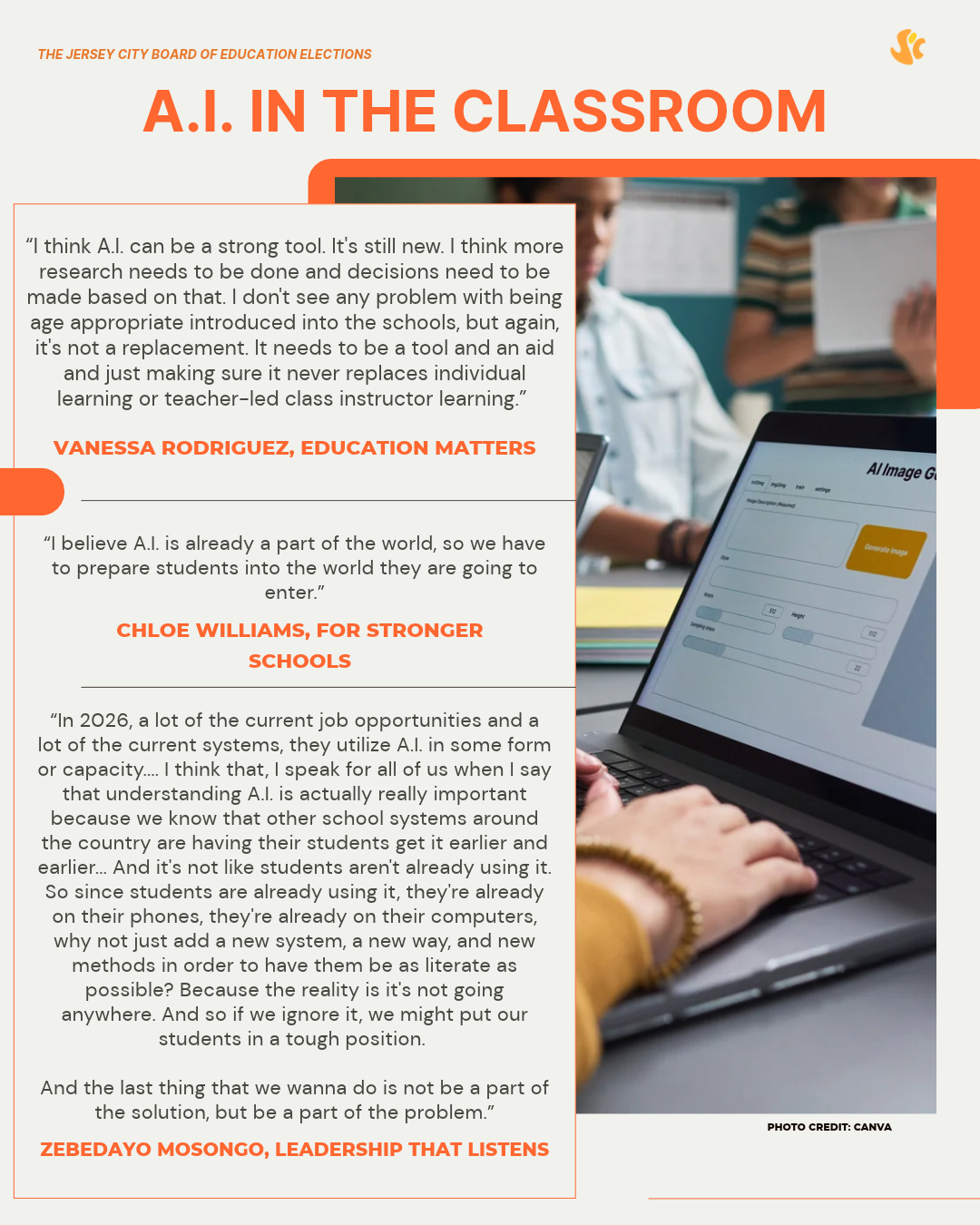
On artificial intelligence (A.I.), the candidates agreed that the technology is already in students’ hands, but they differed on how quickly the district should embrace it.
Mosongo, an educator and attorney running for an at-large seat under the slate of Leadership That Listens, said the district can’t ignore it.
“It’s not like students are not already using it,” he said. “Now the last thing that we would want is to be in a great city like Jersey City… and have students who are not prepared to at least have a base level to understand [ A.I.].”
Williams, a lifelong Jersey City resident and JCPS alumna with more than a decade in youth development who is running with For Stronger Schools, took a similar view.
“I believe A.I. is already a part of the world, so we have to prepare students into the world they are going to enter,” she said.
Rodriguez, who is running for an at-large seat on a one-year term with slate Education Matters, urged more caution.
A mother of a special needs child, she works in the city’s Department of Construction Code Enforcement in a senior position.
“It’s still new. I think more research needs to be done, decisions should be made based on that,” she said.
“It is not a replacement, it should be used as a tool and an aid,” she added, noting that parents have voiced concerns about how A.I. is being integrated into classrooms.
The debate comes as testing in New Jersey is changing. In spring 2027, students in grades 3 through 10 will take the New Jersey Student Learning Assessments-Adaptive in English, math and science, a new format that uses A.I. input.
Why They Think You Should Support Them
Each slate closed by telling voters why it deserves their support.
Vogt, a former deputy chief of staff to Hudson County Executive Craig Guy and former executive director of the Hudson County Democratic Organization, pointed to her experience on the Leadership that Listens slate.
“We all come from different backgrounds and have different experiences that can help us succeed on the board,” she told Slice of Culture. “We are well rounded.”
Blount, a current trustee who also serves on the board of trustees at Pillar College, where he chairs Academic Affairs, stressed deep local roots on behalf of Education Matters.
“We bring to the table a life-long residency in Jersey City,” he said.
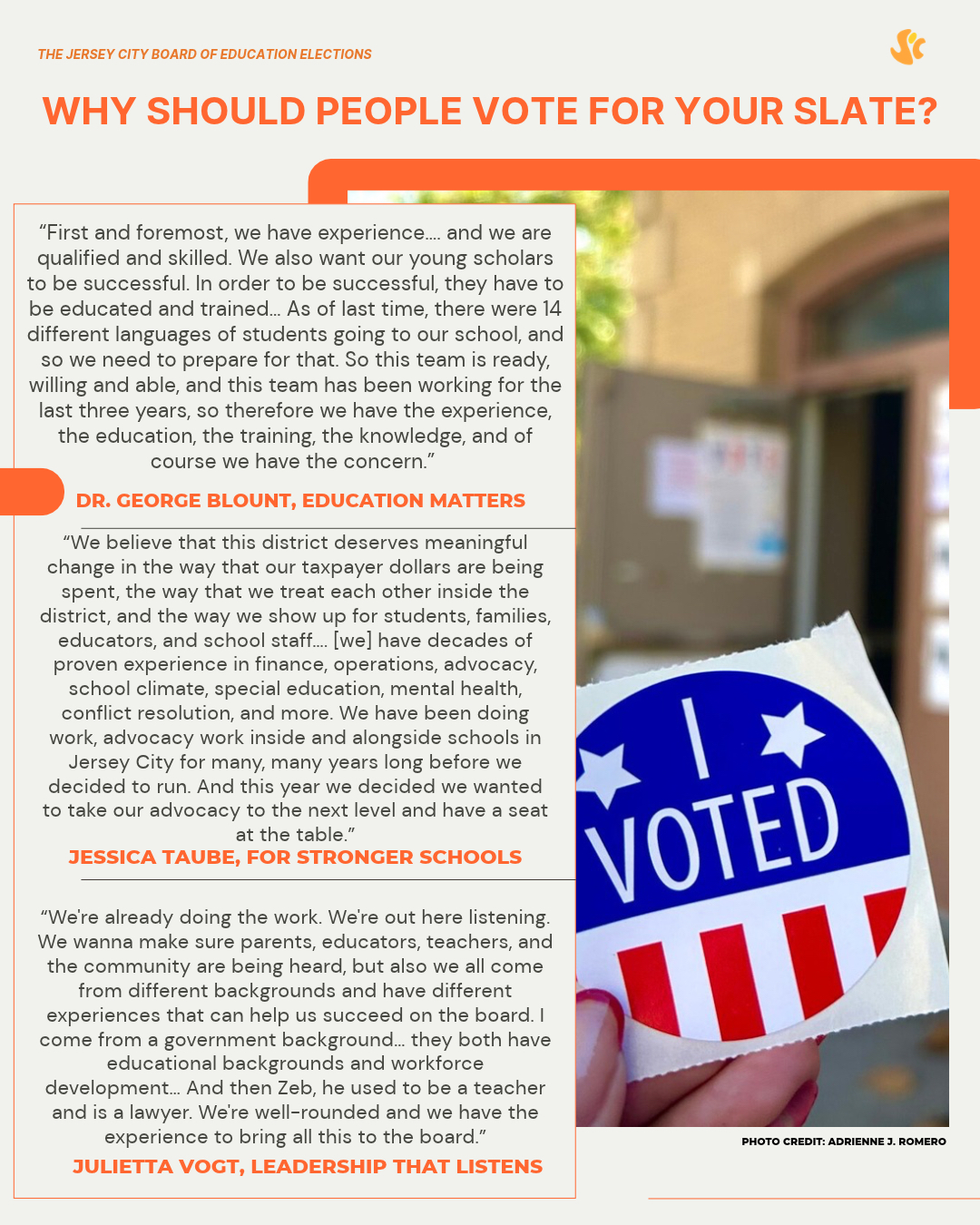
Taube, a parent and licensed social worker who has lived on Jersey City’s West Side for 11 years, called for a change in direction on behalf of For Stronger Schools.
“We believe that this district deserves meaningful change in the way that our taxpayer dollars are being spent, the way that we treat each other inside the district and the way we show up for students,” she said.
“We wanted to take our advocacy to the next level and have a seat at the table.”
What remains to be a talking point among parents, teachers and students is the path moving forward for BOE and how taxpayer money translates into the classrooms in Jersey City.
Help Build JCBOE’s Future
Early voting is set to take place from now until Sunday, Nov. 1 with voting locations throughout Hudson County. You can check out this polling place dashboard to find your nearest polling place.
In addition, this link shows you a general election ballot sample.