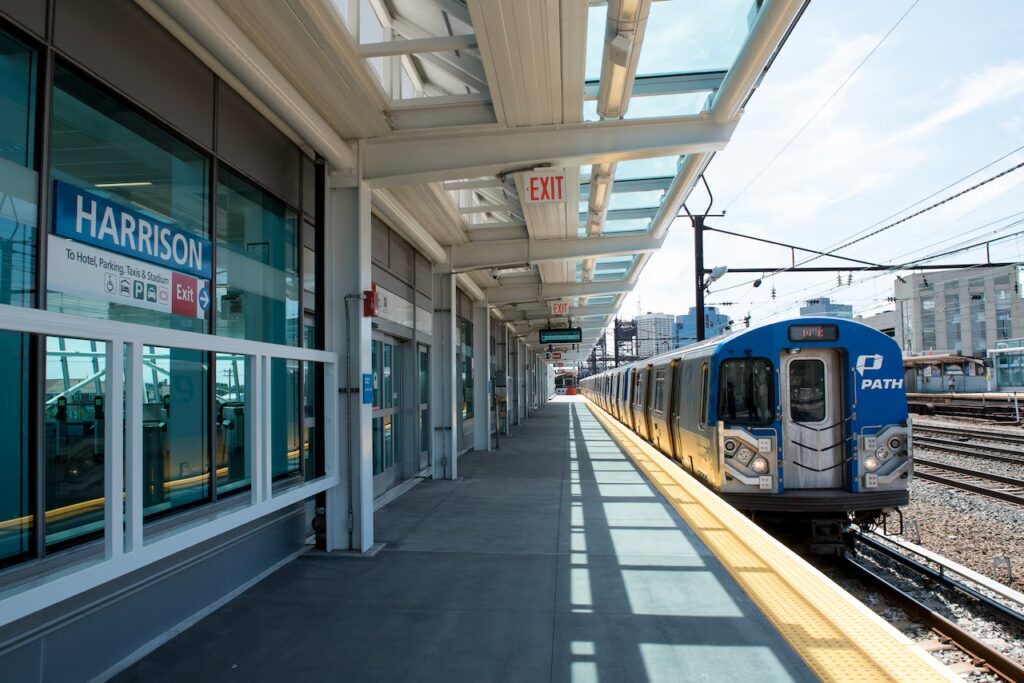
A PATH train arrives at Harrison PATH Station in a file photo. (Reena Rose Sibayan / NJ.com)
The platform at Journal Square is quiet at 5:30 a.m. on a Tuesday. The fluorescent lights hum against the dark. There’s no rush-hour crowd—just a handful of riders, shoulders hunched, eyes fixed on the departures board, running the same mental math they run every morning; Is the 5:39 train going straight through to 33rd Street in Manhattan, or is it going to Hoboken?
For Gianna Thomas, a New York City restaurant worker who makes this trip twice a day, five days a week, the answer to that question determines everything that comes after it. The PATH train is not the last step in her commute—it is the hinge. Miss the right train, lose the bus connection. Lose the bus connection, and the whole route unravels.
“If I miss that train, then I’m 20 minutes late to work,” Thomas said.
She has to clock in at 6:30 a.m.

Thomas is one of thousands of commuters who ride the PATH before most of the city has woken up; this is the same case for essential workers, service industry employees and early-shift laborers for whom public transit is not a convenience but a lifeline.
For this group, a delay is never just a delay. It is a cascading failure: one missed train becomes a reroute, a reroute becomes a backup plan and a backup plan—the 119 bus, the MTA, whatever else is running—can become its own disaster.
On a good morning, Thomas catches the 5:39 a.m. or the 5:49 a.m. out of Journal Square and rides straight to 33rd Street. On a bad one, she does what PATH riders across Hudson County have come to know as an unavoidable tax on their commute: she goes through Hoboken.
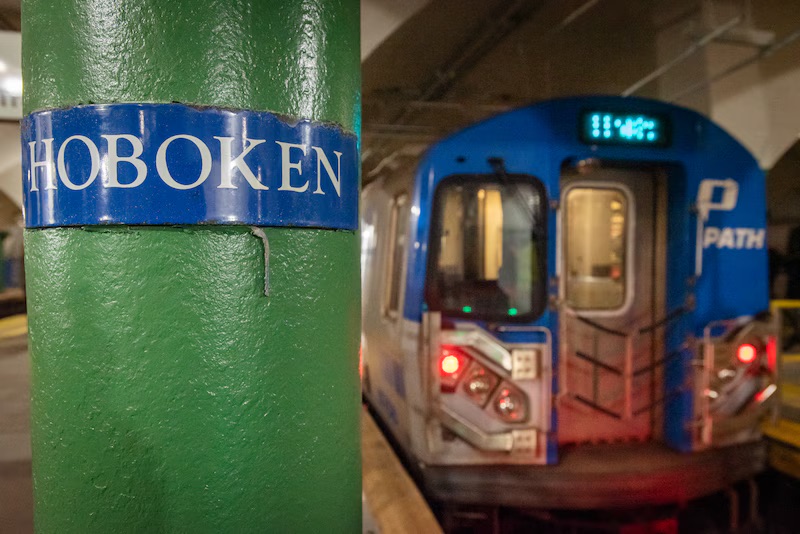
In 2026, bad mornings have been happening a lot.
Over the past two years, the PATH system has been undergoing a $430 million infrastructure rehabilitation effort known as PATH Forward, during which more than 15,000 feet of track were replaced, three new rail switch systems were installed and four major stations—Hoboken, Grove Street, Newport and Exchange Place—received extensive renovations. The work required repeated service reductions and closures across the system.
In March 2026, weekend wait times on the Journal Square–33rd Street line via Hoboken were reduced from 20 to 10 minutes, and weekday morning rush hour trains between Hoboken and World Trade Center began arriving every six minutes instead of every eight.
A Different Kind Of Commuter
The image of the typical commuter—laptop bag, coffee in hand, shuffling onto an 8:15 a.m. train—does not apply at Journal Square before sunrise. The people on the platform at 5:30 a.m. are not heading to offices with flexible start times and work-from-home Fridays. They are heading to kitchens, hospital floors, hotel front desks and restaurant dining rooms. They are the people whose shifts start when everyone else is still asleep, and whose employers do not offer grace periods for a train that decided to go through Hoboken.
Thomas’s schedule is a portrait of that reality. Ten rides a week, every week. The earliest departures Journal Square offers. A clock-in time of 6:30 a.m. that leaves almost no margin between stepping off the train and punching in.
“I’m lucky if I can catch a train from Journal Square straight to 33rd Street. Depending on the day of the week, or how early I get there, I may have to do that mandatory stop in Hoboken,” Thomas said.
But the PATH train is only one link in the chain.
Before she ever reaches Journal Square, she depends on a bus to get her there. That dependency is not incidental—it is structural, and it means that her commute does not have one point of failure. It has several.
“I have to depend on the bus schedule to get me to the correct train. And if I miss that train, then I’m 20 minutes late to work,” said Thomas.
If she sees the bus is running behind, she scraps the route entirely and pivots to the 119 bus into the city, which connects her to the MTA—a system she describes, without hesitation, as “a whole different disaster.”
This is what a disruption actually looks like for an early-morning PATH rider. It is not an inconvenience absorbed into a flexible schedule. It is a real-time triage—a split-second calculation made on a dark platform, under fluorescent lights, before 6 a.m. —about which backup plan fails the least. For workers in industries where showing up late has direct consequences, that calculation carries weight that a delayed commuter on the 8:15 a.m. simply does not feel.
What The Agency Says
Scott Ladd has been PATH’s Communications Director since late 2022. He is, by his own account, a daily PATH rider. When reached for comment on the pattern of service disruptions, he did not dispute the history, he contextualized it.
“We’re 118 years old as a railroad. It’s a very aging system, and we realized a few years ago that we really needed to do a complete overhaul. It was almost a half a billion dollars to do all this work,” said Ladd.
That overhaul is PATH’s Forward program, a multi-year, $430 million infrastructure rehabilitation effort that the agency says will be completed this spring. Central to the project was replacing the system’s interlockings: the mechanical switches that route trains between tracks. Old interlockings failed with what Ladd called “more frequency.” The new ones, he said, do not.
“We replaced all of our interlockings in key areas because the old system was very old and could break down more frequently,” he said. “The new ones do not.”
Ending The ‘Around the World’ Detour
The Hoboken detour—the route Gianna calls a 30-minute tax on her morning—has a name inside PATH’s own offices. Ladd used it without irony.
“We call it ‘around the world’: where you go from Journal Square up to Hoboken and then into the city,” said Ladd. “We’re eliminating that.”
Starting May 17, PATH says weekend riders traveling between 10 a.m. and 9 p.m. will go direct from Journal Square to 33rd Street. The change, Ladd acknowledged, came partly in response to sustained pressure from community advocacy groups in Jersey City who had grown increasingly critical of the detour and the long waits between trains.
“They used to be very critical of us—now they’re kind of our biggest fans,” said Ladd.
What stands out in Ladd’s account is the role outside pressure played. The technical capability to run direct service was there; what shifted, by his own telling, was the volume of community criticism that preceded it.
Notably, the direct service will only run between 10 a.m. and 9 p.m. and on the weekend —leaving the earliest morning departures during work days, the ones Thomas and workers like her depend on most, still subject to the detour.
The Off-Peak Gap And What’s Coming
The off-peak weekend hours have long been PATH’s most glaring hurdle. For years, the system ran trains with gaps of up to 40 minutes between departures, which is a standard that would be considered untenable on nearly any other transit system serving New York.
“For a long time, we were running 40-minute waits between trains, which is an awfully long time. And if you’re in the city, you’re out to dinner, you’re coming home late—the last thing you want to see is ‘next train in 38 minutes.’ That’s all going away,” said Ladd.
PATH says those wait times will be cut in half as part of the May rollout, with further reductions to the Newark–World Trade Center line planned for next year. And for the first time since the aftermath of Sept. 11, the agency is restoring full seven-day service across all four lines—a milestone Ladd calls “every line, every day.”
“For the first time in a quarter century, we’re going to have all four of our lines operating seven days a week,” he said. “We hadn’t had HobokenWorld Trade Center trains on the weekends since after 9/11. And now we’re back to full strength in a way we haven’t been in 25 years.”
That a post-9/11 service reduction persisted for 25 years without full restoration is, on its own, a story PATH has not been asked to tell loudly. The agency did not offer an explanation for why it took this long.
A Cost That Doesn’t Show Up In The Data
The Port Authority has, in recent months, framed its service disruptions as the necessary cost of long-overdue infrastructure investment. Riders on the early morning platforms at Journal Square have a different way of putting it. They are the ones paying that cost in late arrivals, lost wages and mornings that start with uncertainty before they have even left New Jersey.
Ladd, for his part, speaks about the system with the conviction of someone who believes the changes coming in May will matter.
“I like the idea of being involved with something that really affects people’s lives every single day,” he said.
Thomas does not need to be told that PATH affects her life every day. She already knows. She calculates it every morning at 5:30 a.m., under the fluorescent hum of Journal Square, watching the departure board and hoping the 5:39 goes straight through.
The May 17 changes are real, and if they hold, they will mean something for the workers who have had no margin for error. But for the riders who have absorbed detours, 40-minute gaps and suspension notices as a routine part of their commutes, the proof will be on the platform — before the city wakes up — where the board either says on time or it doesn’t.
Riders can track service in real time through the following:
- Service alerts: panynj.gov/path/en/alerts.html
- Official PATH website: panynj.gov/path
- X (Twitter): @PATHTrain — the agency’s most active channel for real-time delay notices
- TAPP app: Available on the App Store and Google Play for fare management and service updates.