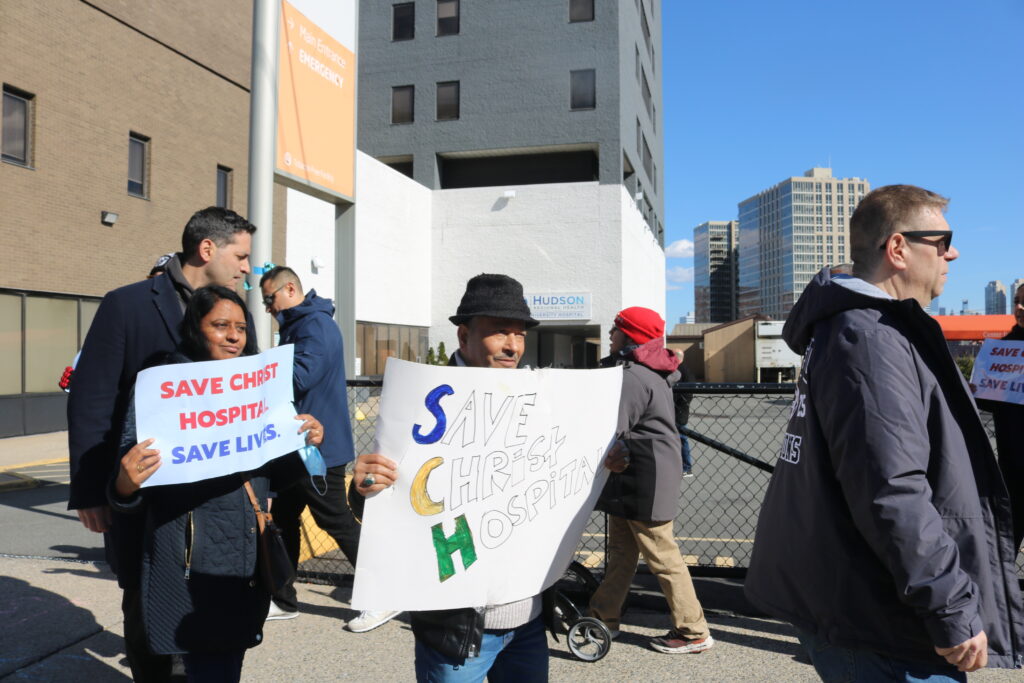
A rally in March in front of Christ Hospital before its abrupt closure. Photo by Jordan Coll / SOC Images.
In a court hearing that stretched for nearly an hour, a decision by a judge in Hudson County Superior Court would pave the way for a public hearing to take place, after the abrupt closure of the University Heights Hospital—better known as Christ Hospital—eight months ago.
For months, the community has been on a tit-for-tat with the closure of one less hospital in Jersey City which first opened up in 1872, has now sent ripple effects in the healthcare landscape.

In court, the point up for litigation was the decision of Heights University Hospital to close without adhering to a public hearing under a 30-day period addressing the impacts of the closure–instead the hospital operator just closed. It started off with the hospital waning off on critical departments and reducing staff workers prior to the entire closure of the emergency department.
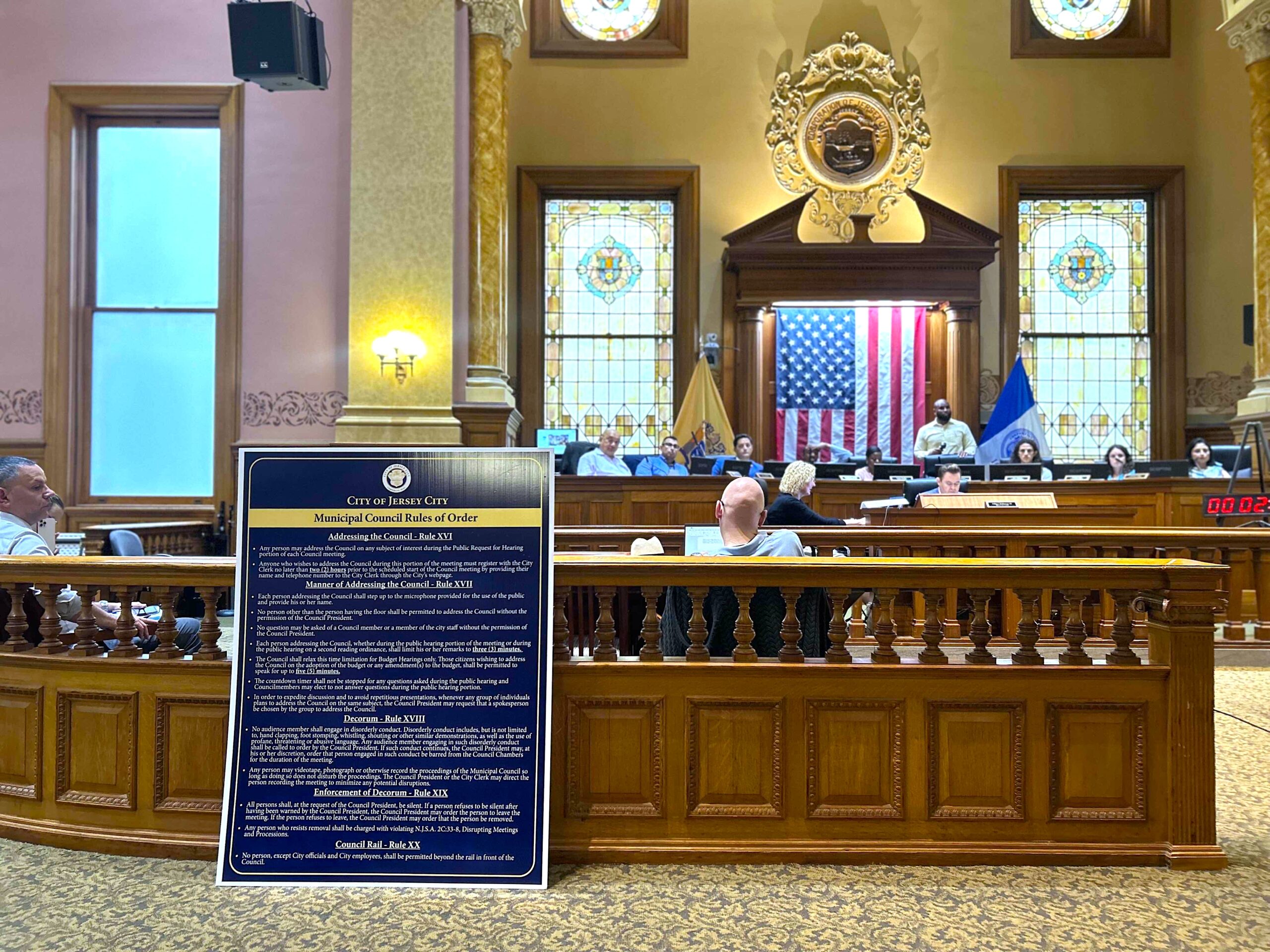
During the court hearing on Thursday, June 18, at the Hudson County Administration Building, three motions were before Judge Brian Katz:
- One filed by Hudson Regional Health, the plaintiff, seeking to convert the temporary restraining order (TRO) into a preliminary injunction while the case proceeds
- A motion to intervene filed by property owner Avery Eisenreich
- A motion to dismiss for lack of jurisdiction filed by the New Jersey Department of Health (NJDOH)
Slice of Culture was in the room throughout the court hearing. The final decision by the judge will be today at 2:30 p.m. through Zoom and press and the public can join in via a livestream: https://www.njcourts.gov/public/channels.
The Crux Of The Issue: How Harmful Is Christ Hospital’s Closure?
Arguing on behalf of HRH, attorney Joseph Franck told Katz that HRH retains the right to withdraw its Certificate of Need (CN-3) application to close Heights University Hospital, and that doing so would end any “further review” or consideration of the matter.
“There has been no public emergency declared,” said Franck addressing the judge, immediately afterwards members of the public chastised his claims.
“I know they [NJDOH] are trying to dodge the issue and claim they do not have the duty and burden to demonstrate that the public is going to be harmed,” he added.
The plaintiff argued that under NJ state regulations, applicants are granted the right to withdraw the CN3 document before final agency action of the approval or rejection of the 30-day process.
“This is not a matter of discretion. This is a matter of the agency exceeding its regulatory authority,” said Franck.
He also added that no direct relationship existed between the current healthcare operator and the landlord.
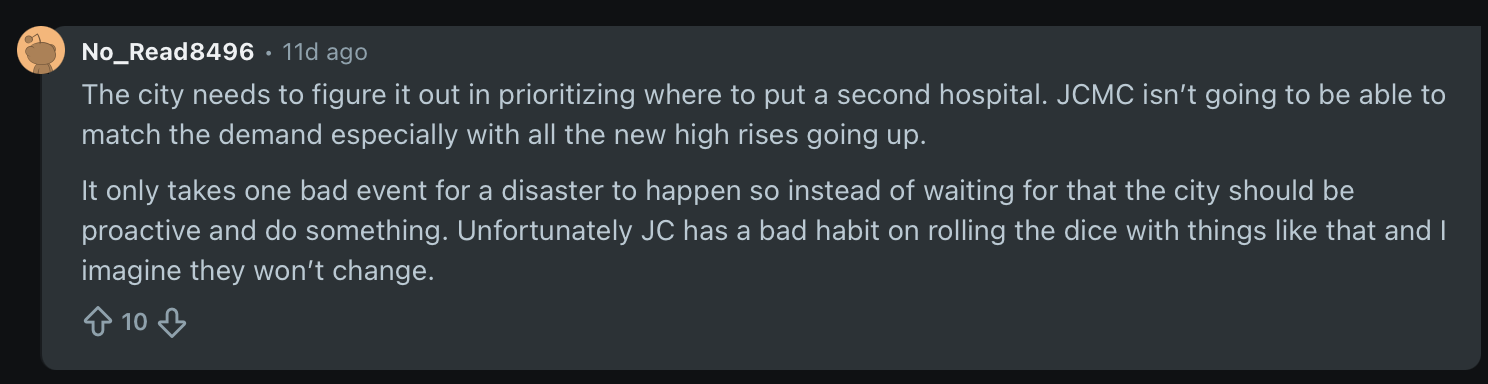
People have taken to social media to rebuke the hospital’s closure, along with its public on the healthcare grid of Jersey City.
“The city needs to figure out in prioritizing where to put a second hospital,” said one user on social media. “Unfortunately JC has a bad habit on rolling the dice with things like that and I imagine they won’t change.”
The plaintiff, Heights University Hospital, filed a preliminary injunction to halt the closure, citing regulatory requirements and potential harm to public health, just less than three hours before the public hearing was set to take place with residents of Jersey City back in April, as previously reported by Slice of Culture.
The Back And Forth Of Christ Hospital
But what has reached a point of bureaucratic limbo, among several parties—including HRH, Avery Eisenreich (the current landlord of the property), Renne Steinhagen (an attorney at NJ Appleseed, a nonprofit legal firm) and Francis Baker representing NJDOH—were back and forth in court, ironically debating on a hospital that had already been closed to begin with, bypassing the 30-day state mandate for review.
Steinhagan, who was a representative on behalf of the public, said that this case, “Can be seen as a complete victory for Jersey City residents,” she told Slice of Culture.
She added that the judge was able to discern the legal procedures when it came to the abrupt closure of a healthcare facility, “in particular the role of the public hearing,” which she said cemented the legal threshold of further review and claimed that HRH did not act in “good faith.”
On Jersey City’s front, Mayor James Solomon blamed Hudson Regional Health for deliberately dismantling services at Christ Hospital and flouting state requirements governing how healthcare facilities must be closed.
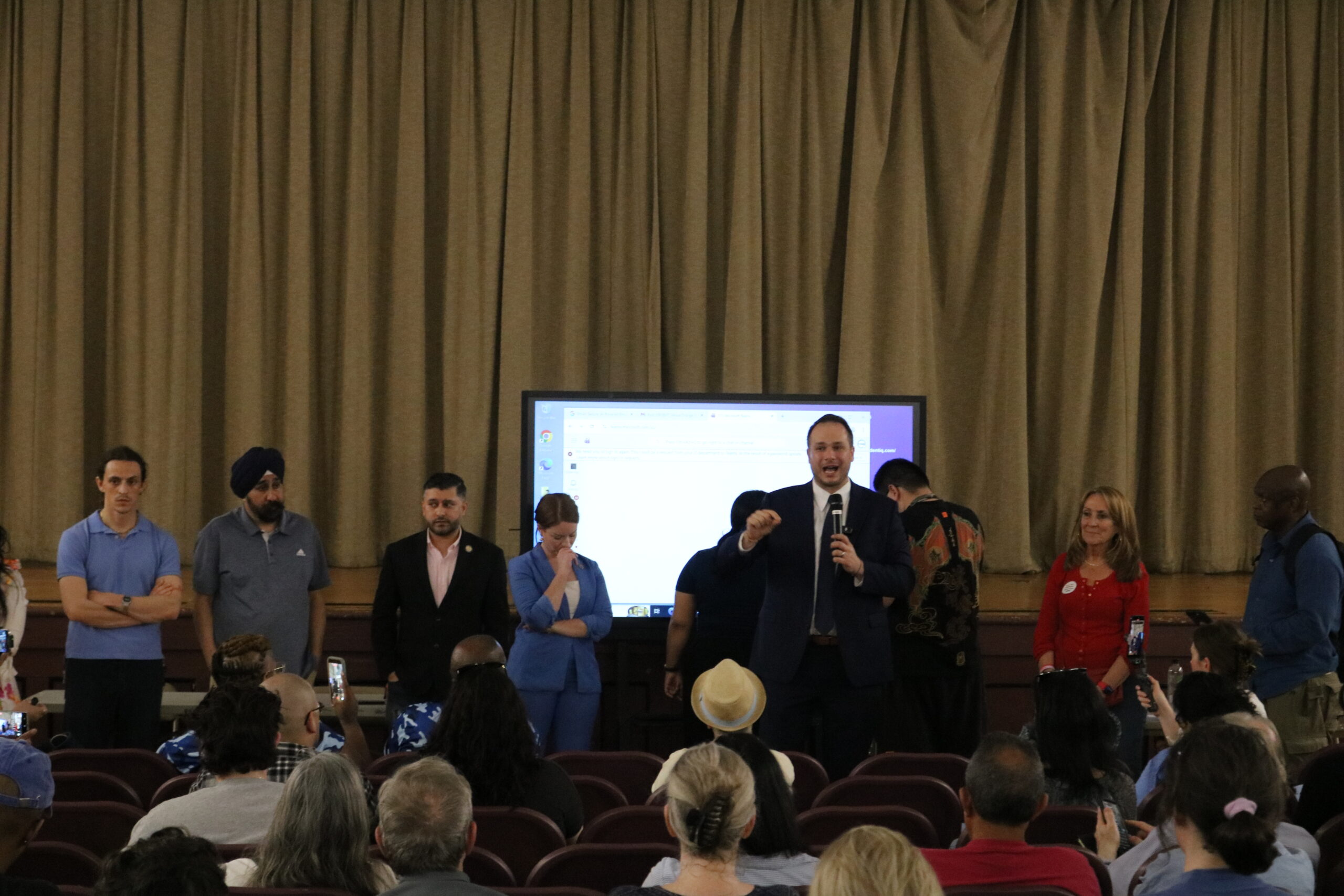
The city then moved for an emergency injunction in Superior Court, contending the operator had bypassed legally mandated procedures before shuttering a facility that served a city of roughly 300,000 residents.
Baker said that since the hospital closure on March 14—when the emergency department shut its doors—the hospital had been fined a total of $120,000 in penalties, which have yet to be collected, as told by the case’s defense.
He added that the injunction undermined the state’s own legal process when it came to proceeding with the status quo of reviewing a CN3 application.
“There is absolutely a massive harm to the department [NJDOH], which you have legislative mandate to oversee the administration of public health, and we are not able to do that if there is an injunction that has prevented us from considering or looking at the current healthcare landscape in terms of ‘state public inclusion,’” as Baker phrased it.
The meeting was set to take place on April 15, instead in just a few hours notice, HRH filed a restraining order against the NJDOH staff members, adding on to an injunction that deemed the meeting “unofficial.”
On the crux of the hospital’s timeline, the certificate of need process was harked on in court.
Defense added, “Applicants can express [a withdrawal request], but it has to be granted or expressed, the department has to consider whether the consequences of the withdrawal would be in light of the enabling statute and regulations,” which he added are in direct conflict with the Health Care Facility Act on the closure of Heights University Hospital.
The state then argued that the CN3 regulations must be read in full statutory context.
“Is there any overlap between the hospital’s ownership and the landlord?,” asked the judge, inquiring on the nature and time period of when HRH was set to close.
The judge also acknowledged a jurisdictional challenge when it came to injunction filed by HRH from the get-go and also the hospital being stripped away of federal reimbursement eligibility grants.
“I’ve never come across a situation close to seven months [of closure]–who would be planning for [reopening] a hospital in order to address those financial circumstances? Figure out what happened and how do you fill these gaps,” said the judge, who welcomed a scenario where the hospital could open up.
The NJ Department of Health refused to allow the withdrawal and insisted on proceeding with the review. The hospital then sought a preliminary injunction in court to stop the department from continuing, which has been the baseline of the legal feud of it all.
A Community Waiting To Be Heard
The court concluded that the hospital did not have the right to withdraw its CN application post-closure. The DOH can now proceed with the public hearing and the court allowed the complaint to proceed.
Slice of Culture requested a comment from the City of Jersey City on HRH’s attempt to absolve the medically used zone—legal red tape developers are seeking to get rid off—and if they would appeal the case. The city said they cannot comment on pending litigation.
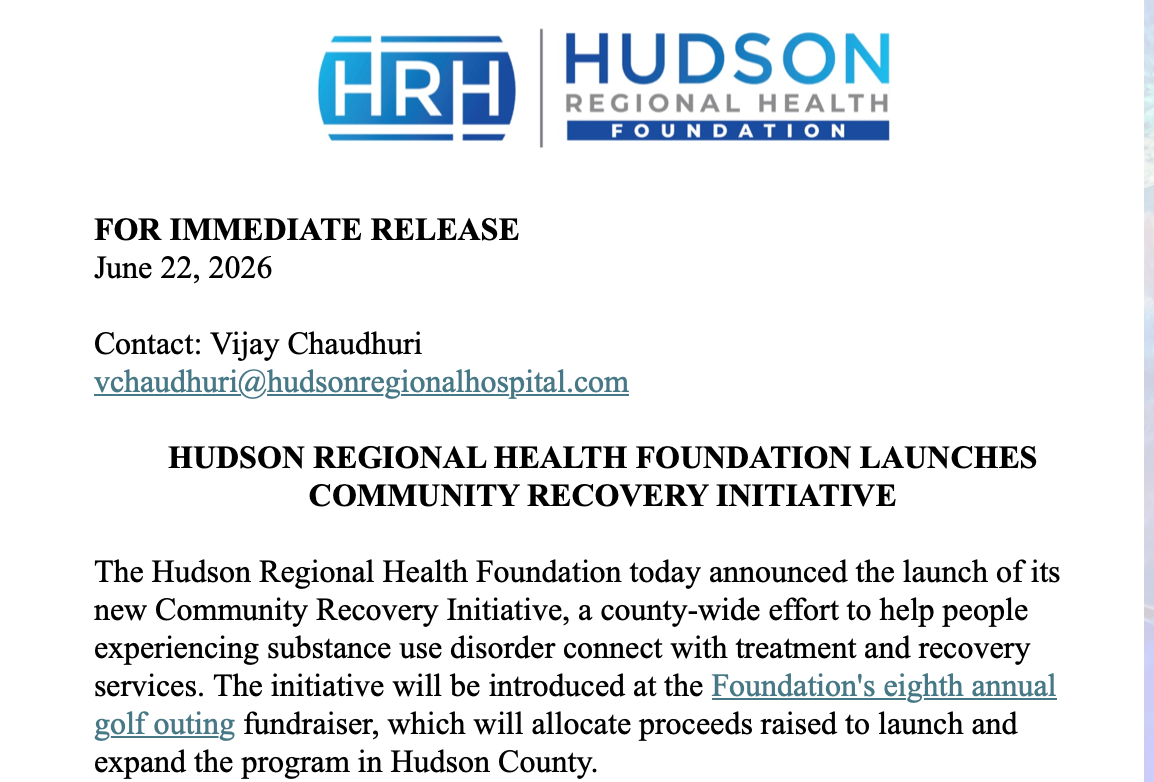
In the meantime, HRH recently announced the new launch of a Community Recovery Initiative, a community health center intended to provide medical relief for substance use disorder individuals or needing recovery services, according to a presser circulated to Slice of Culture.
“As has been stated numerous times, a plethora of challenges beyond HRH’s control contributed to the extremely precarious financial state of Heights University Hospital,” said Vijay Chaudhuri, the spokesperson for HRH in an email statement to Slice of Culture.
“These include tens of millions of dollars of cuts to county, state and federal funding, an antiquated building that has lived well past its useful life, a majority underinsured patient population and serious mismanagement by the prior owner, among others.”
What remains to be seen is when the date for the public hearing can take place, and if the retention of hospital facilities can be made, in a city with one remaining hospital left in service.
“To claim that there has been no public harm is totally absurd,” said Caitlin Duffy, communications director for Save our Hospital, a coalition aimed at preserving the 349-bed unit hospital. “We cannot accept this as the new normal,” she added.
“To claim that there has been no public harm is totally absurd. We cannot accept this as the new normal.”
– Caitlin Duffy, communications director for Save our Hospital, a coalition aimed at preserving the 349-bed unit hospital