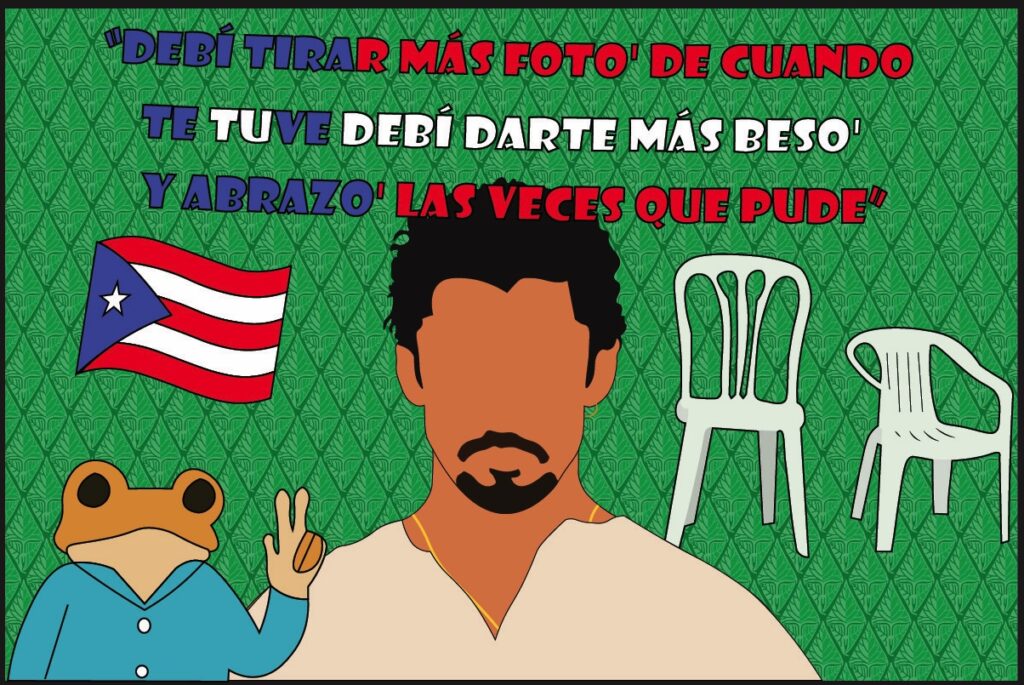
Graphic by Edward Andilema / SOC Images.
Writer Gus Nations also contributed to this article.
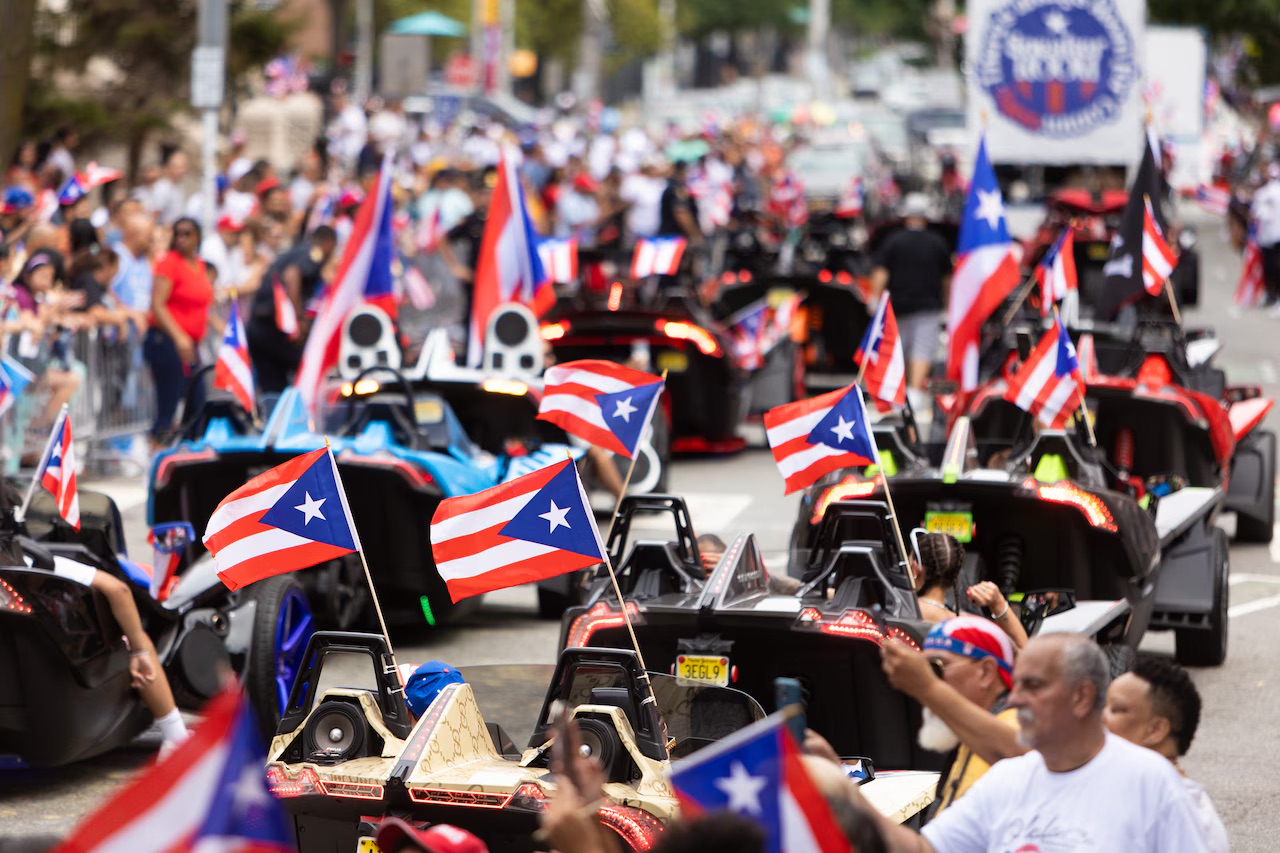
Hudson County is home to roughly 289,000 Hispanics, including 52,055 Puerto Ricans. But beyond the numbers, Puerto Rican culture comes to life in the streets; it’s heard in music—consisting of congas and the güiro, sometimes mixed with trap beats—blasting from a passing car, it’s seen in giant Puerto Rican flags tucked into the hoods of cars and it’s celebrated, subtly, with Puerto Rican flag pins, boxing gloves and a plate of pernil.
And with the latest release of Bad Bunny’s album, “DeBÍ TiRAR MáS FOToS”—“I Should’ve Taken More Photos”—and the recent wrap-up of his 31-night concert residency “No Me Quiero Ir De Aquí”—”I Don’t Want To Leave Here”—the Puerto Rican-born artist has strengthened pride and encouraged resiliency in not just Puerto Ricans, but all Latinx living in Hudson County too.
Angely Reyes, who previously lived in Puerto Rico and now lives in Union City, told Slice of Culture “Debí Tirar Más Fotos” resonates hard with her and her Dominican heritage.
“It makes me feel proud to be Latina because with his music, Bad Bunny brings the Latino culture and flavor to the rest of the world because Dominicans and Puerto Ricans are very similar when it comes to certain traditions/customs,” Reyes said, translated from Spanish.
More Than A Love Letter
Benito Antonio Martínez Ocasio, better known as Bad Bunny, released “DeBÍ TiRAR MáS FOToS” (“DTMF”) on Jan. 5 earlier this year.
“DTMF” quickly hit music charts, becoming the No. 1 project on Billboard’s Top Latin Albums, the No. 2 on the overall Billboard 200, No. 1 on Top Streaming Albums and No. 1 on the Latin Rhythm Albums charts. Many reviews labeled “DTMF” as a “love letter” to Puerto Rico, but a deeper dive from LATINA—a magazine created as an authoritative voice for Latina women in the U.S.—wrote that saying that “oversimplifies” what Benito is doing.
“This album is a warning to all Puerto Ricans—both those residing in Puerto Rico and in the diaspora—about the state of their “archipélago perfecto” (as he refers to Puerto Rico in the album’s closing track “LA MuDANZA”), and a rallying cry to address the myriad crises facing their homeland,” Vanessa Diaz and Petra Rivera-Rideau wrote.
Puerto Rico became a U.S. territory in 1898 after the Spanish-American War. Since then, it continues to stand as a “political paradox” due to “government mismanagement”—prolonged effects of Hurricane Maria, COVID-19 and frequent electricity outages—forcing the island into a cycle of economic crises, U.S. colonialism and an overall yearning for justice and sovereignty.
You can hear the themes in many of the 17 tracks.
“TURiSTA”: “Tú solo viste lo mejor de mí y no lo que yo sufría” (“You only saw the best of me and not what I suffered“)
“LO QUE LE PASÓ A HAWAii”:
“Quieren quitarme el río y también la playa,” (“They wanted to take my river and my beach“)
“Quieren el barrio mío y que abuelita se vaya” (“They wanted my neighborhood and for grandma to get out.”)
But the struggle isn’t exclusive to Puerto Rico, which Bad Bunny acknowledges satirically in his “NUEVAYoL” music video, which was dropped on July 4, the same day of the U.S.’s independence day from the Great Britain. Towards the end of the video, there’s an AI-generated voice mimicking U.S. President Donald Trump, who delivers an apology:
“I made a mistake. I want to apologize to the immigrants in America. I mean the United States. I know America is the whole continent. I want to say that this country is nothing without the immigrants. This country is nothing without Mexicans, Dominicans, Puerto Ricans, Colombians, Venezuelans, Cubans.”
In an article titled “Bad Bunny’s “NUEVAYoL” and the Decolonial Pulse of Pop Culture,” Convergence Magazine writer David Sathuluri analyzes how Benito continues Puerto Rican resistance.
“This moment of political fantasy—Trump acknowledging immigrant contributions rather than demonizing them—serves as a powerful critique of the current political moment. Congress had passed Trump’s “One Big Beautiful Bill” on July 1, 2025, just three days before the video’s release. This massive legislation allocated $170 billion for immigration enforcement and border security, including $45 billion for ICE detention expansion and $30 billion for deportation operations. The video closes with the message “Juntos Somos Más Fuertes” (Together We Are Stronger), positioning unity across Latinx communities as a response to state violence.”
Una Más (One More)
Bad Bunny’s concert residency, “No Me Quiero Ir De Aquí,” kicked off on July 11 and ended on a surprise show this past Sunday, Sept. 20. The first nine of those were exclusive to Puerto Rico residents only.
After the 31 days, CNBC reported that the artist added roughly “$400 million to Puerto Rico’s economy with nearly 600,000 attendees” and “helped sustain tourism on the island during its off-season months of August and September.”
The surprise show on Sunday, “Una Más,” was livestreamed on Amazon Music where Bad Bunny displayed the struggle and joy of Puerto Rico and Latinx diaspora throughout the world, including right in Hudson County, New Jersey.
The three-hour concert showcased Puerto Rico in its full form, including a surprise performance from fellow Boricua legend, Marc Anthony, who sang “Preciosa.”
Amazon Music and Bad Bunny are also now partnered in an initiative that will focus on “propelling education, cultural empowerment, and economic development to create meaningful change across Puerto Rico,” including STEM curriculum, technology resources, education support and farmers assistance and improvement.
Reyes told Slice of Culture that she’s proud of her culture and wants to help more people learn about it.
“Saber qué personas que no hablan español se sientan interesados por conocer el idioma y la cultura, me hace sentir orgullosa de mi cultura y me siento responsable de representar a mi país de la mejor manera posible para que más personas en mi ambiente quieran conocer más sobre nosotros. Es muy bonito ver como personas en mi trabajo hablan bien de mi país y se alegran por ir de vacaciones y bañarse del calor Dominicano.”
“To know that people that don’t speak Spanish are interested in knowing the language and culture, makes me feel proud of my culture and I feel responsible in representing my country in the best way possible so that more people around me want to learn more about us. It’s very beautiful to see how people at my job speak highly of my country and are happy to go on vacations to visit and enjoy the Dominican heat.”
– Angely Reyes